Chapter Two: Extending the Comet Hypothesis
We call the impact event described in the previous chapter the "main event" because it lies at the heart of Earth's geological history. But the same wave of nitrogen-ice comets did not target Earth alone; other bodies throughout our solar system bear the scars of these collisions.
Evidence Across the Solar System
- Mercury: The Caloris Basin is a remnant of one such massive impact.
- Mars: The Hellas Impact Basin is another comet strike — and, as we will see in the next chapter, a remarkable Earth twin.
- The Moon: The South Pole–Aitken Basin — one of the largest known impact basins, and centered almost exactly on the lunar south pole — traces back to this same period of bombardment.
- Saturn's Rings: A large nitrogen-ice comet, captured by Saturn's gravity, contributed to the formation of the planet's iconic rings.
Intriguingly, many of these basins and rings sit near the southern polar regions of their respective worlds. This pattern reveals a directional quality to the comet storm — a broad sweep across the solar system from a single orientation. We return to that pattern, and what it means, in the next chapter.
The Impact Scenario
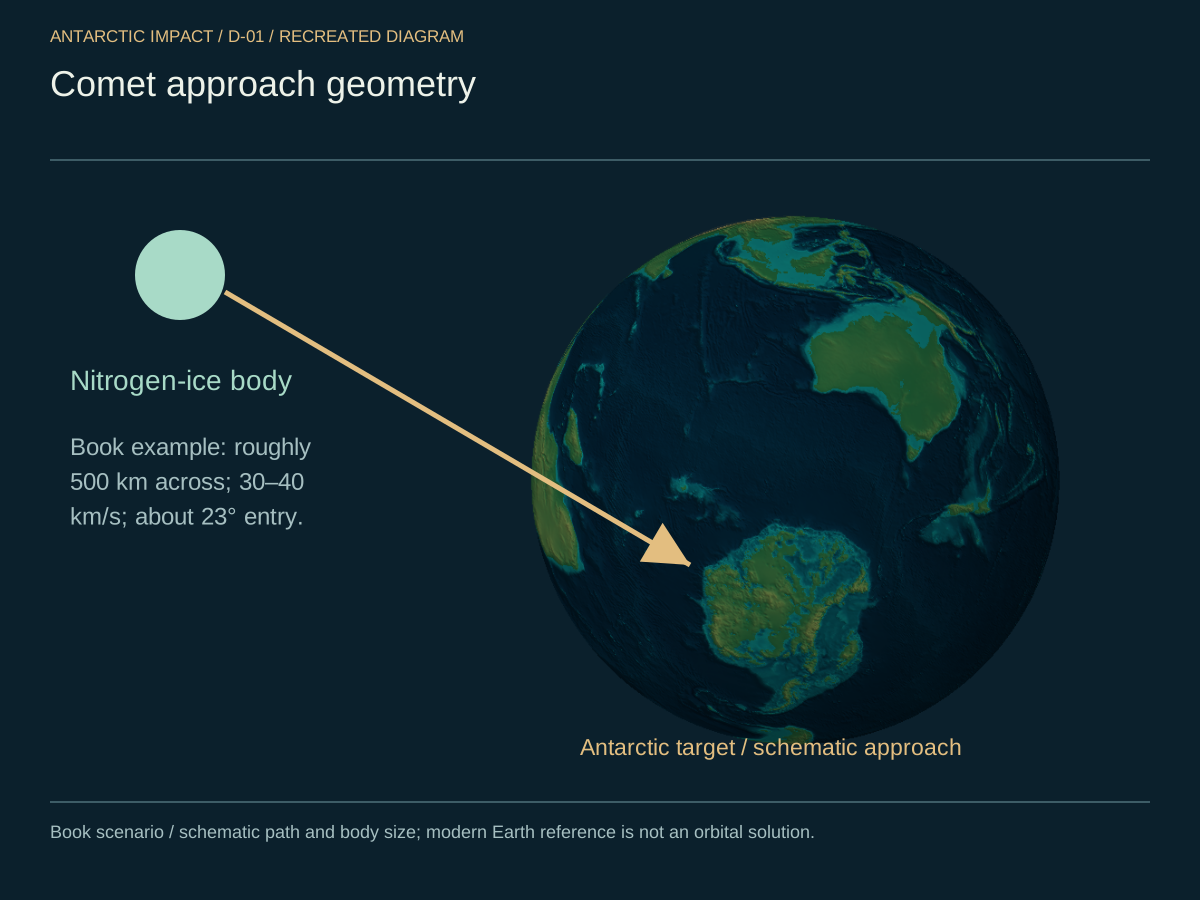
Here is the geometry we are working with. Earth with the South Pole tilted toward us. The comet trajectory comes in at about twenty-three degrees. Roche-limit fragmentation begins out at thirteen thousand kilometers altitude, atmospheric entry at one hundred kilometers, impact at Wilkes Land.
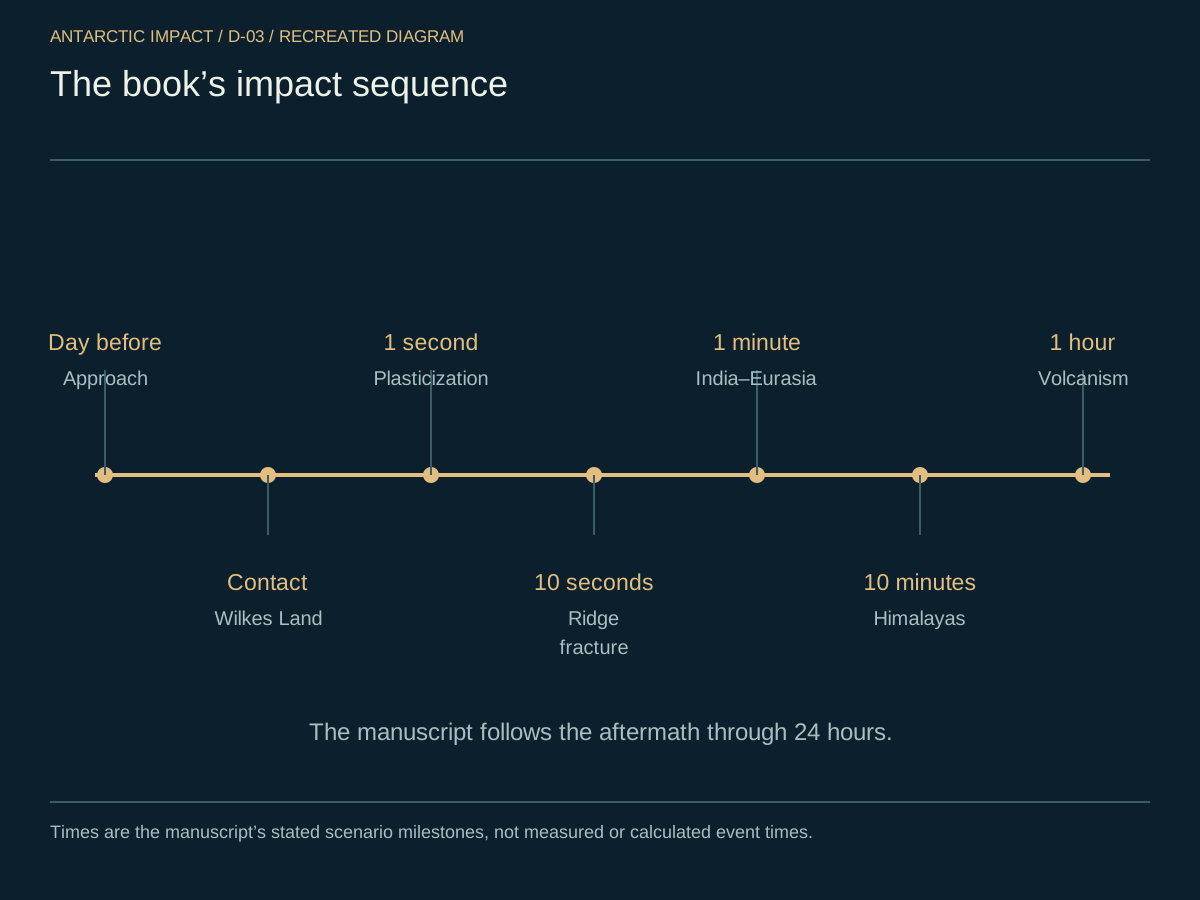
And here is the sequence again — the day in question, from approach through aftermath — because in this chapter we walk through the actual mechanics of contact, and that timeline is the spine of the section.
Imagine a compressed, dense nitrogen-ice body, roughly five hundred kilometers in diameter — not a fluffy, loosely packed snowball but a body whose interior has been squeezed by self-gravity into something with the density of compressed nitrogen ice, around a thousand kilograms per cubic meter. Now picture this comet barreling toward Earth at thirty to forty kilometers per second — roughly sixty-seven to ninety thousand miles per hour. As it nears our planet, it crosses its own Roche limit — the distance inside which tidal forces can rip the body apart — and begins to fragment.
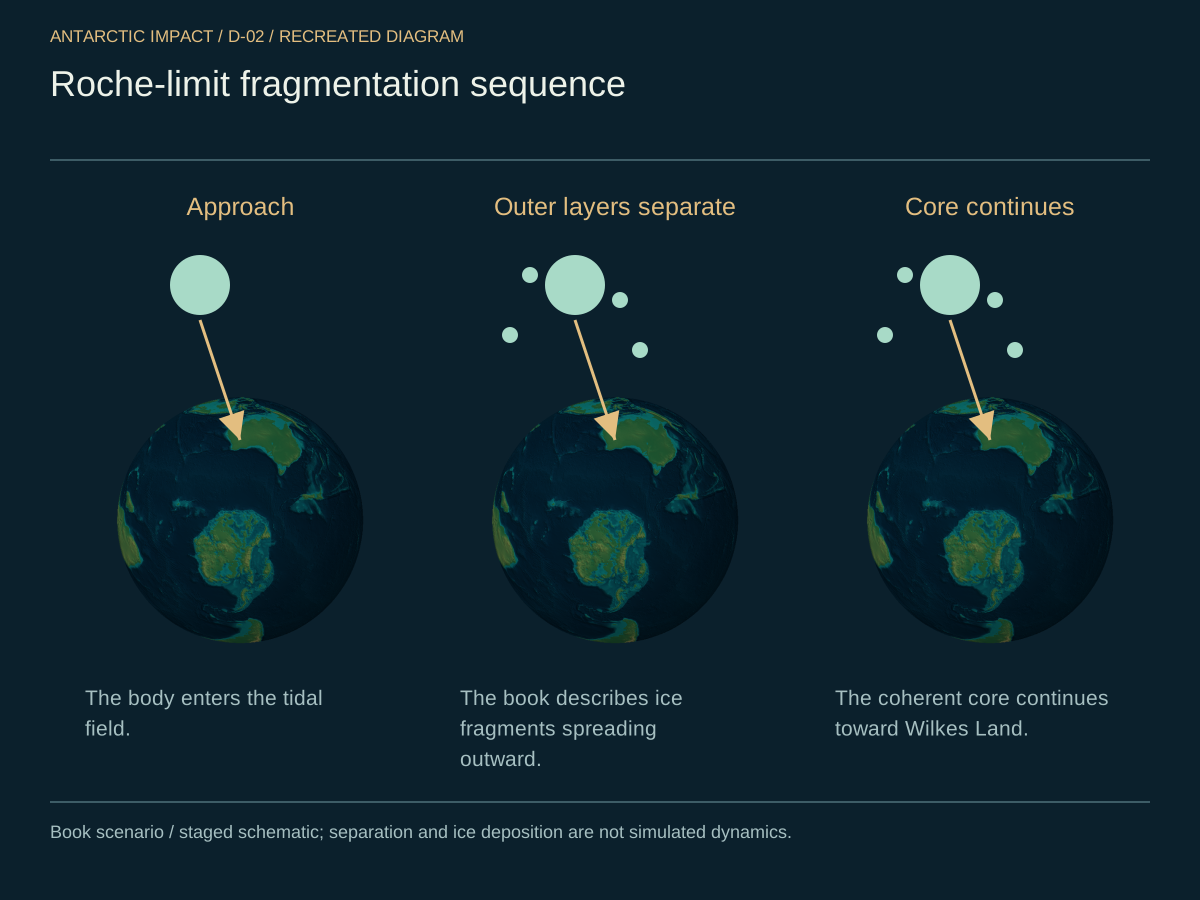
The Roche distance depends on density: for a rocky object near Earth, the limit sits around nine and a half thousand kilometers above the surface; for the lower-density nitrogen-ice case, it is closer to thirteen thousand kilometers — about eight thousand miles. That is where the comet's outer mantle begins to shear away, raining miles-thick chunks of snow and ice across the upper atmosphere. The pieces that fall out spread the comet's outer skin around the planet as global ice deposition — what we recognize as the Ice Age. But the compressed core, dense and structurally coherent, survives the shearing and continues inward.
Picture it in three panels. First, the intact comet approaching. Second, at the Roche limit, tidal forces tear off the outer mantle while the compressed core holds together. Third, post-crossing — fragmented mantle showering down globally, dense core continuing on to impact. That is the splitting we are talking about.
The core slams into the supercontinent at an angle of roughly twenty-three degrees. The impact delivers enough energy to fracture and separate that landmass. The Earth's crust, momentarily plasticized by the colossal energy release, shifts dramatically. As it cools and solidifies, mountain ranges, rift valleys, and ocean basins take shape — giving rise to geographical features such as the Rockies, the Andes, the Appalachians, the Ring of Fire, and more.
Cometary Chemistry: What Space Missions Tell Us
We know more about what comets are made of now than we did when we first sketched out this hypothesis. The Giotto mission, in 1986, flew through Halley's Comet and measured something like a quarter to a third of cometary dust as organic material — formaldehyde, complex hydrocarbons, amino-acid precursors. Decades later, Rosetta detected glycine — the simplest amino acid — in the coma of Comet 67P/Churyumov–Gerasimenko. Halley's nucleus turned out to be among the darkest objects ever photographed in the solar system, coated in carbonaceous material.
This matters in two ways. First, a comet does not merely deliver kinetic energy and ice; it delivers complex organic chemistry. Second, alongside the nitrogen ice that made up the comet's bulk, an Earth-impacting body of this scale arrived carrying a payload of carbon-rich material — material we will revisit in Chapter Four when we discuss the rapid formation of oil and natural gas.
Our impactor was a body of the outer solar system — a child of the Pluto belt, nitrogen-ice dominant, unlike the water-ice comets of the short-period family that Giotto and Rosetta visited. That composition is what let a single body deliver something on the order of ten to the eighteenth or nineteenth kilograms of nitrogen to Earth in one event.
Why Nitrogen Ice?
It is worth pausing to say why the comet was nitrogen ice rather than water ice or rock. The evidence points that way for five reasons.
First, nitrogen ice sublimates — it goes directly from solid to gas — under conditions where water ice would melt and pool. This explains the absence of a five-hundred-kilometer crater: the bulk of the cometary material did not stay put long enough to leave one, having vaporized into the atmosphere instead.
Second, Earth's atmosphere is roughly seventy-eight percent nitrogen — far more than the inner solar system alone can readily supply. A large nitrogen-ice impact is the source.
Third, the observed three-hundred-foot post-impact sea-level rise is the signature of a partly sublimating nitrogen-ice comet. A water-ice body of comparable mass would have lifted sea levels far more dramatically; a nitrogen-ice body deposits part of its mass as ice that later melts, and gives much of the rest to the atmosphere.
Fourth, cometary nitrogen carries its own isotopic fingerprint — one we describe in Chapter Four, and one that Antarctic chemistry points toward.
Fifth, the rest of the solar system already shows us that large nitrogen-ice surfaces are common: Pluto, Triton, and several trans-Neptunian objects all have them. We are not invoking an exotic substance. We are invoking a substance the outer solar system has in abundance.
Aftermath: Melting, Sublimation, and Survival
Because these comets are largely composed of nitrogen ice, they sublimate very quickly, releasing additional heat into the atmosphere. For the human populations alive at the time, the consequences were dire:
- Rapid Melting: Massive snow and ice deposits began to melt, raising sea levels and triggering widespread flooding.
- Seismic and Volcanic Unrest: Earth's freshly fractured crust convulsed with tectonic and volcanic activity.
- Climate Chaos: The planet's climate lurched toward a new equilibrium, with extreme weather persisting for generations.
- Nitric Acid Rain: Subliming nitrogen, combining in the upper atmosphere with oxygen, produced nitric acid as a transient component of the post-impact rainfall — a corrosive chemical insult on top of the seismic and climatic ones.
Humanity — "the genetic remnants of the survivors" — endured extended periods of darkness, frigid conditions, or both until the skies eventually cleared. Over time, grasslands and forests reemerged, allowing people to leave caves, rebuild, and establish new civilizations. Myths of Atlantis, of global floods, of fallen skies — these are the deeply embedded cultural memories of that cataclysm.
The Global Fracture Pattern
Several of the world's most prominent geological features are the radiating cracks of a single, central impact. Read them that way and the map of the world comes into focus.
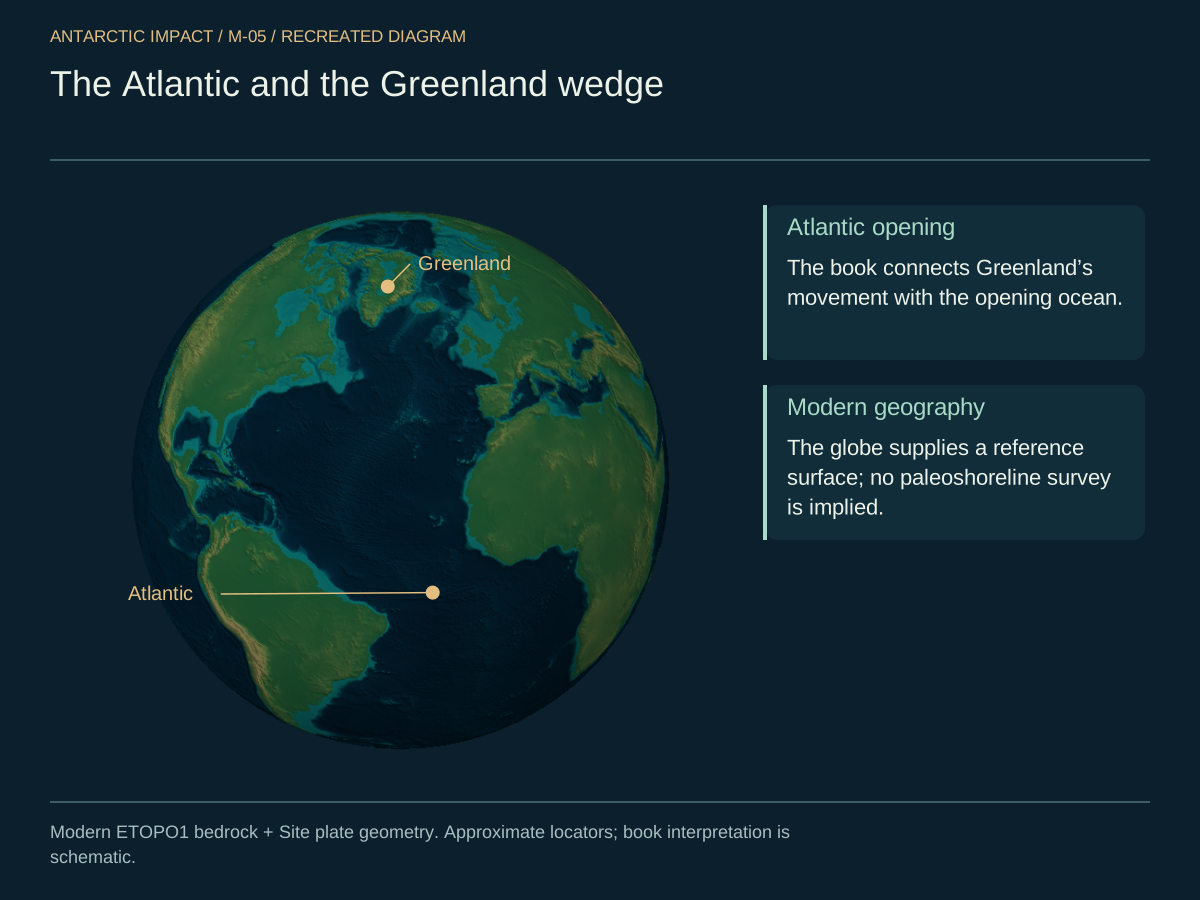
The Greenland Wedge and the Atlantic Opening. Look at a globe with the central impact in mind and Greenland stops being a quiet ice-covered island in the North Atlantic and starts looking like the keystone in an arch that broke. Greenland served as a wedge between what is now North America and Eurasia — a hard, dense block that rode the northern arc of the global land wave and, as the wave passed through, drove the Atlantic open behind it. South America and Africa, which had been part of the same continental mass, pried apart along the line we now call the Mid-Atlantic Ridge. The coastlines of West Africa and eastern South America still match each other the way two pieces of a torn page do — the famous observation every schoolchild learns. The tear is recent. The wedge above did the work. The geometry is exactly what you would expect.
Look at the Atlantic with Greenland's pre-impact position drawn in. Dashed: where Greenland sat before the strike, wedged into the proto-Atlantic margin between North America and Europe. Solid: where it sits now. The arrow shows the northward translation, and the Mid-Atlantic Ridge is the trailing rift.
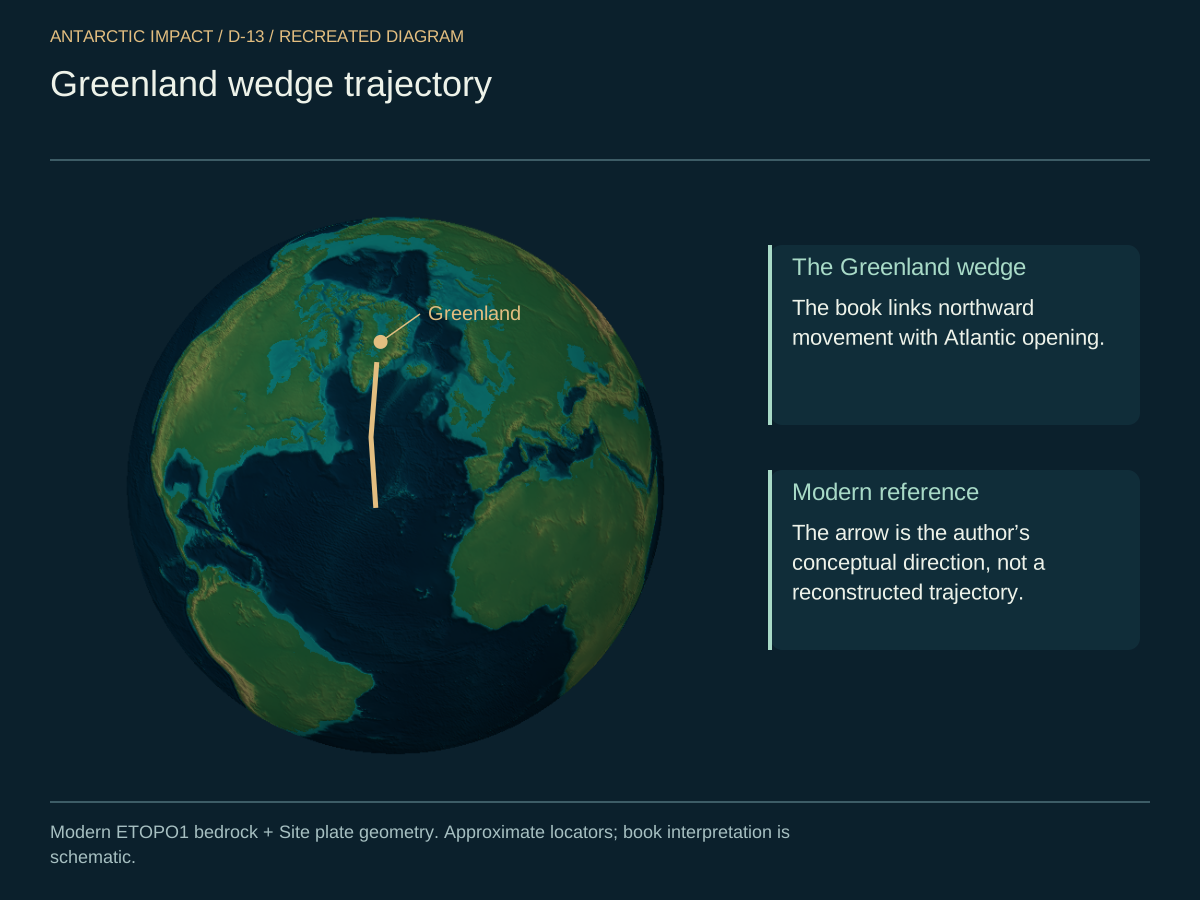
And the same picture on the bathymetric map — the Mid-Atlantic Ridge running pole to pole, with the Greenland wedge above.
The Andes and the Altiplano. The Andean cordillera, with its high plateau (the Altiplano) and its abundance of marine fossils at elevation, has the geometry of a land wave that wrapped around the western side of South America and pinched the continent.
Here is the chain in topographic detail — the cordillera, the Altiplano, and the marine fossils standing in country that has no business holding marine fossils unless something lifted it fast.

The Ring of Fire. The Pacific Ring of Fire, with its concentration of volcanism and earthquakes, traces a roughly circular pattern: a great pressure-release ring around the impact zone.
Plot the Ring of Fire on a single great-circle arc and roughly seventy-five percent of Earth's volcanoes and ninety percent of its earthquakes line up along one near-circular envelope. That is geometry, not weather.
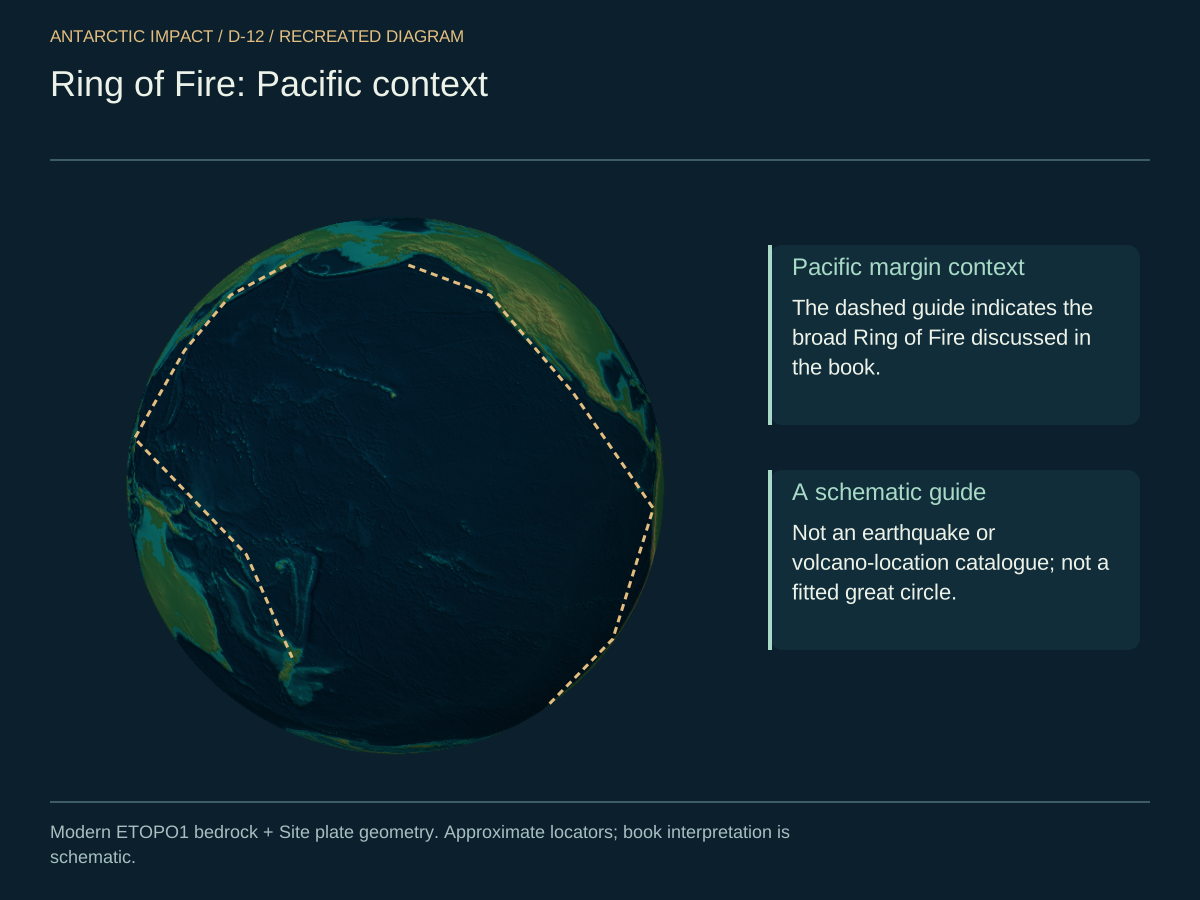
And the same Pacific basin, drawn as a bathymetric map.
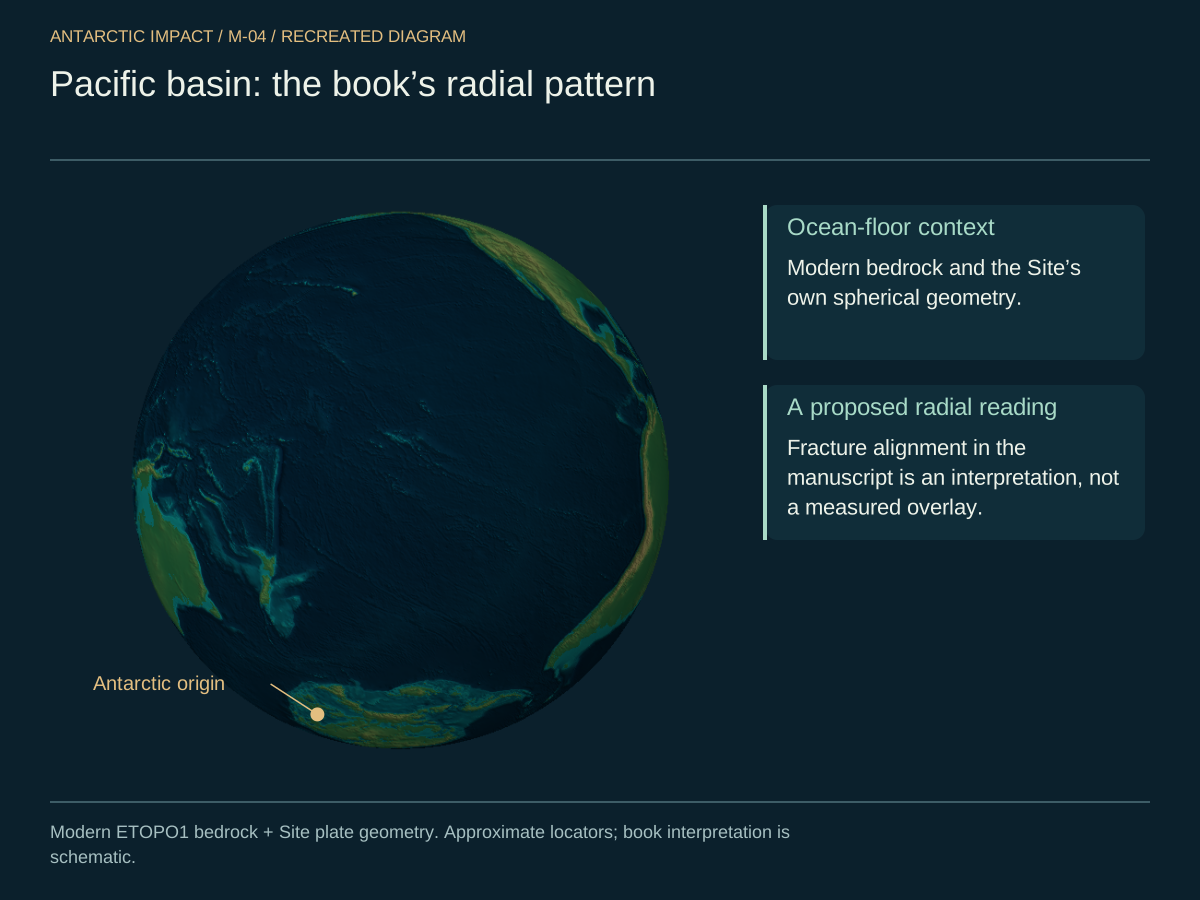
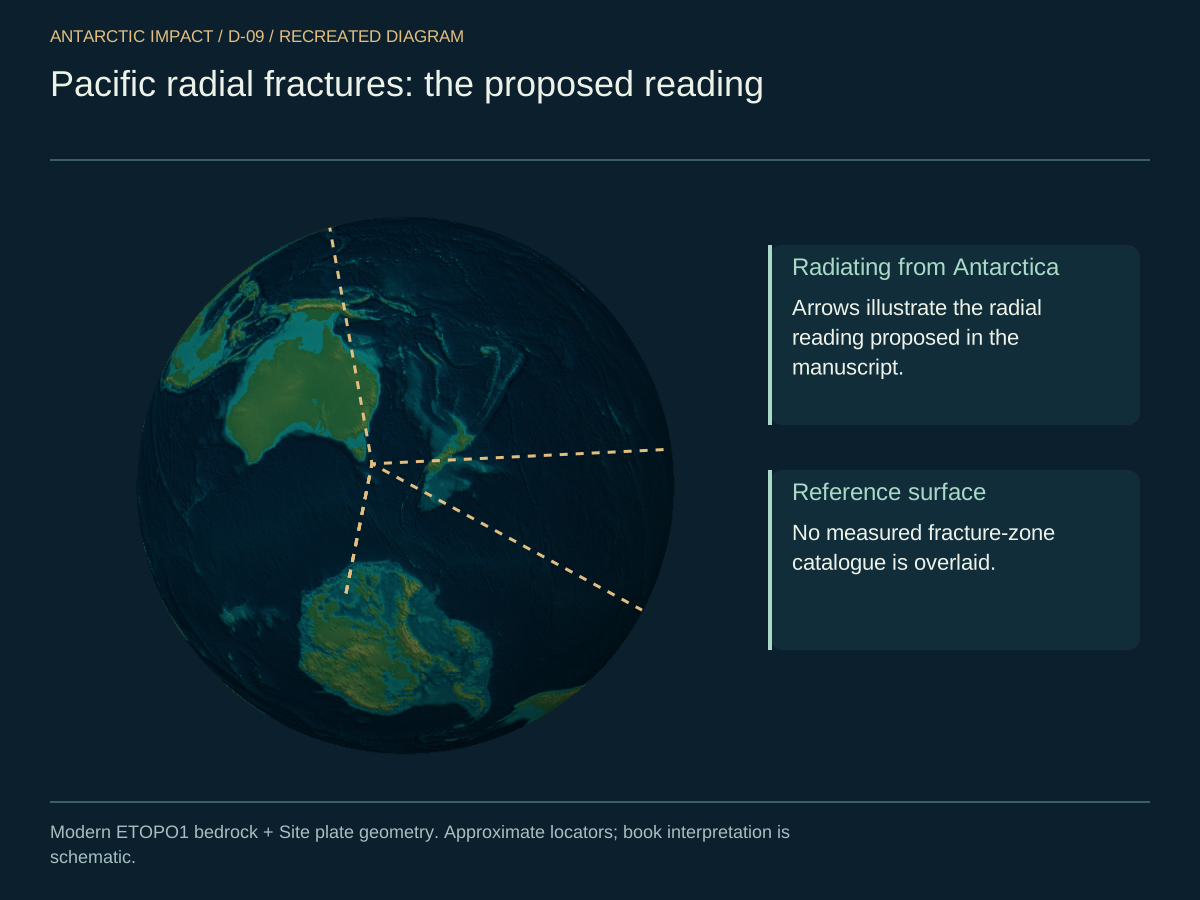
Now the companion projection — the major Pacific fracture zones, Mendocino through Easter, projecting radially toward Antarctica. These are not stretching cracks. They are radial cracks, the kind a windshield develops when a single rock hits it.
The San Andreas Fault. The San Andreas, with its young, fresh expression, is a recent fracture in the Pacific–North American margin.
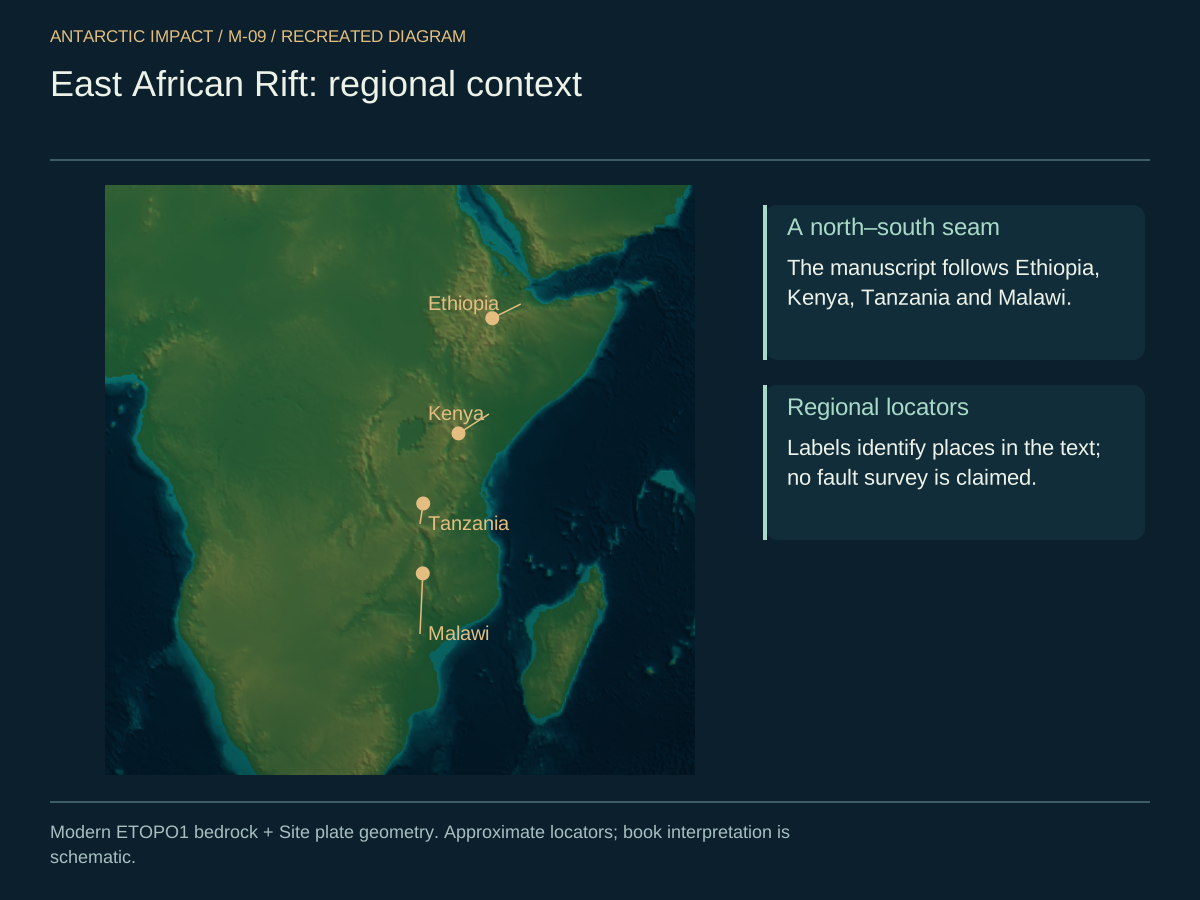
The East African Rift Valley. The impact's shock front is still rebalancing under our feet, and the East African Rift is what that rebalancing looks like on the surface. Run a line down through Ethiopia, Kenya, Tanzania, Malawi — a continent being pulled apart along a seam, a great elongated furrow opening from north to south with active volcanism (Kilimanjaro, Nyiragongo) and chains of long deep lakes (Tanganyika, Malawi) lining up along its length. The rift is a continent still working out the residual stresses of a global land wave, the energy of the central impact still seeking equilibrium in the African crust thousands of years after the fact. A continent does not need millions of years to start tearing. It needs the right force, applied once, hard.
Run your eye down the rift on the map and what you see is a seam, not a smear.
The Himalayas: Built in Minutes
The Himalayas are where the land wave did its most visible work. Three observations tell the story:
- Heights beyond anything else on Earth. The highest peaks on the planet, concentrated in a single chain — too high and too sharp to have been standing against erosion for tens of millions of years.
- Marine fossils at extreme elevation. Whale bones reported above twenty-five thousand feet, marine shells along the Tibetan Plateau. Sea floor, lifted into the sky in one motion.
- The Great Bend alignment. The Himalayas curve sharply where the Indian subcontinent meets Eurasia — and the curve points directly back along the line of the Ninety East Ridge, which itself points back to Antarctica.
Together, they read as a land wave that briefly softened the crust and lifted a mountain belt in minutes rather than millennia.
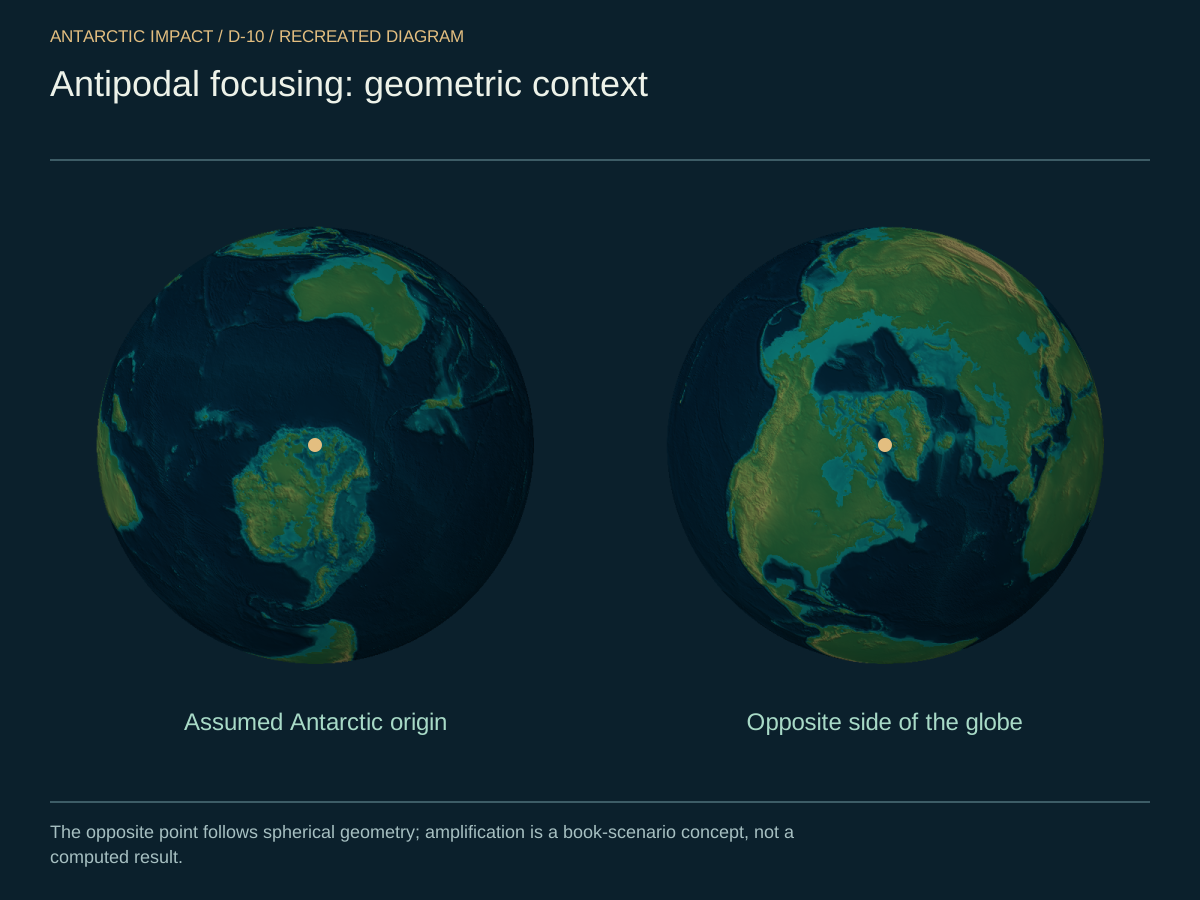
The mechanism is antipodal focusing. Picture Earth in cross-section, the impact at one pole, the shock wave propagating through the mantle and converging on the far side — and the bulge that converges there is the Himalayas and the Tibetan Plateau.
Before and After: Pangea, Then the Modern World
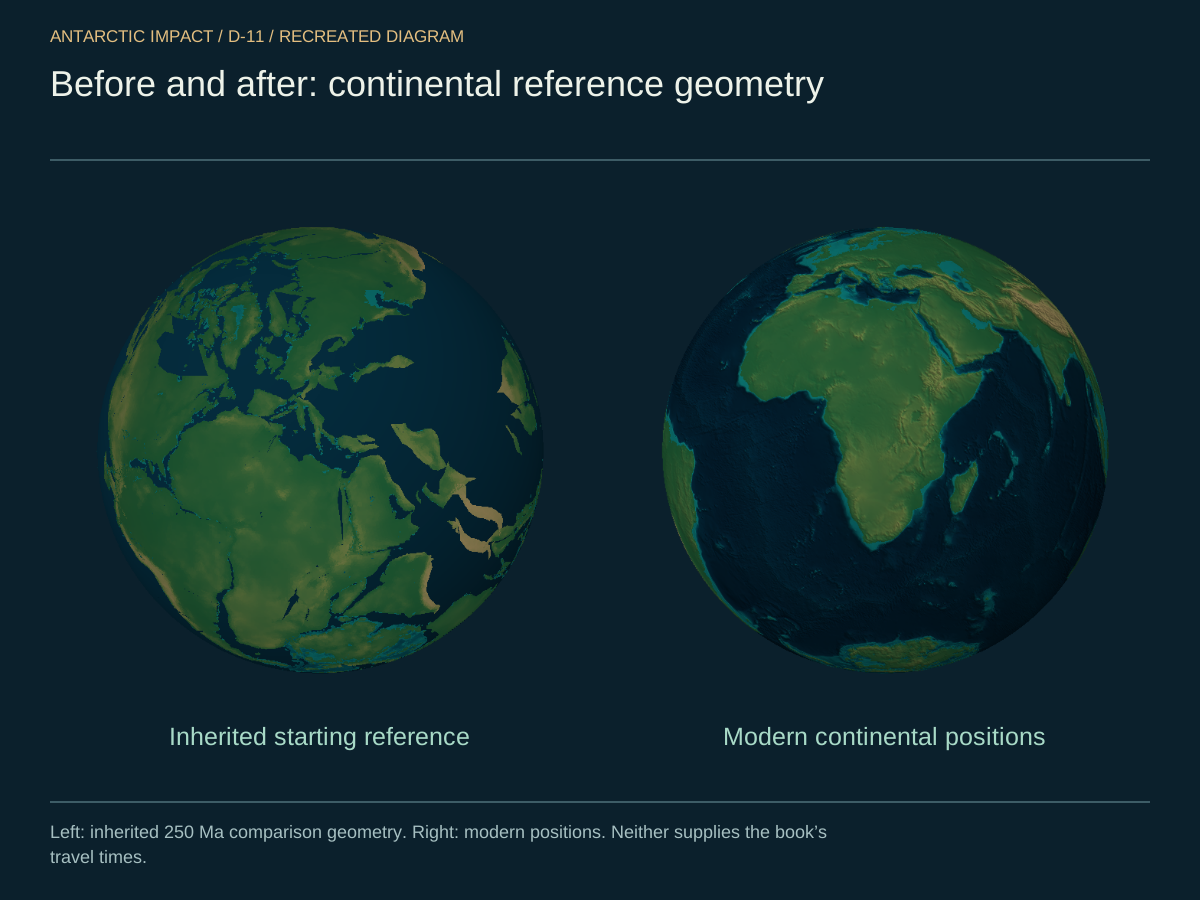
Put the two pictures side by side. Left globe: pre-impact, the supercontinent largely intact, Antarctica at its pre-impact latitude. Right globe: today, with arrows showing the post-impact trajectories radiating outward. The journey from the left globe to the right was not an eon. It was an afternoon — and the fifteen thousand years since have been the settling.
A Widening Lens
Modern space probes and telescopes — Viking, Messenger, Giotto, Juno, Cassini, New Horizons, the Mars Reconnaissance Orbiter — have revealed a dynamic solar system marked by ongoing impacts, geological upheaval, and shared histories among celestial bodies. When we compare the southern polar basins on Mercury, the Moon, and Mars with the features on Earth, a larger pattern emerges: a wave of comet impacts that irrevocably altered multiple worlds.
The chapters ahead follow that wave outward — to the other worlds it struck, to the creatures it buried, to the people who lived through it, and to the distant planet that set it loose. Read on with a globe in your mind's eye, south pole up.