Chapter Seven: The Resurrection
Revisiting the Aftermath
In previous chapters, we have explored how the comet impact at Antarctica reshaped Earth's geography — creating new mountain ranges and ocean basins, melting vast quantities of ice and snow, and raising sea levels by around three hundred feet. We have also touched on how humans, as survivors of this cataclysm, dispersed across the globe in the wake of such upheaval.
Now we turn our attention to a critical question: how did humanity make it through this event, and what did our world look like before the impact?
Life Before the Impact
If our species survived the cataclysm, logic dictates we existed beforehand. The comet impact broke the unified pre-impact supercontinent apart — which raises the question: what was human life like before Earth was torn asunder?
- Ecology and Climate. Before the disaster, Earth's equatorial regions hosted shallow, warm seas inhabited by dinosaur-like creatures, while higher latitudes carried mammalian megafauna such as mastodons. With little or no axial tilt there were no seasons: day and night the same length everywhere, the tropics warm year-round, the higher latitudes steady.
- A Green Antarctica. Antarctica itself was not the polar wasteland of today but a temperate, vegetated land — the land that produced the coal deposits we still find beneath its ice. The pre-impact south polar region was inhabited, in a way no part of the modern continent is.
- Human Societies. Were we advanced enough to see the comet swarm coming? Did some groups prepare, while others ignored the looming danger?
These questions point to a complex human civilization — more sophisticated than we assume — scattered across a unified landmass and, crucially, across coastal regions that are now under three hundred feet of seawater.
Going Underground
In many mythologies and legends, we find stories of hidden worlds beneath Earth's surface — sometimes referred to as Agharta, Shambhala, or "Hollow Earth" concepts. Even historical figures like Adolf Hitler famously chased the idea of an underground civilization. There is a kernel of truth hidden within these tales.
Cappadocia is real. So are the long-known subterranean cities of Derinkuyu, Kaymakli, and the rest. Look at the map of known and suspected refuge sites and the pattern is not subtle.
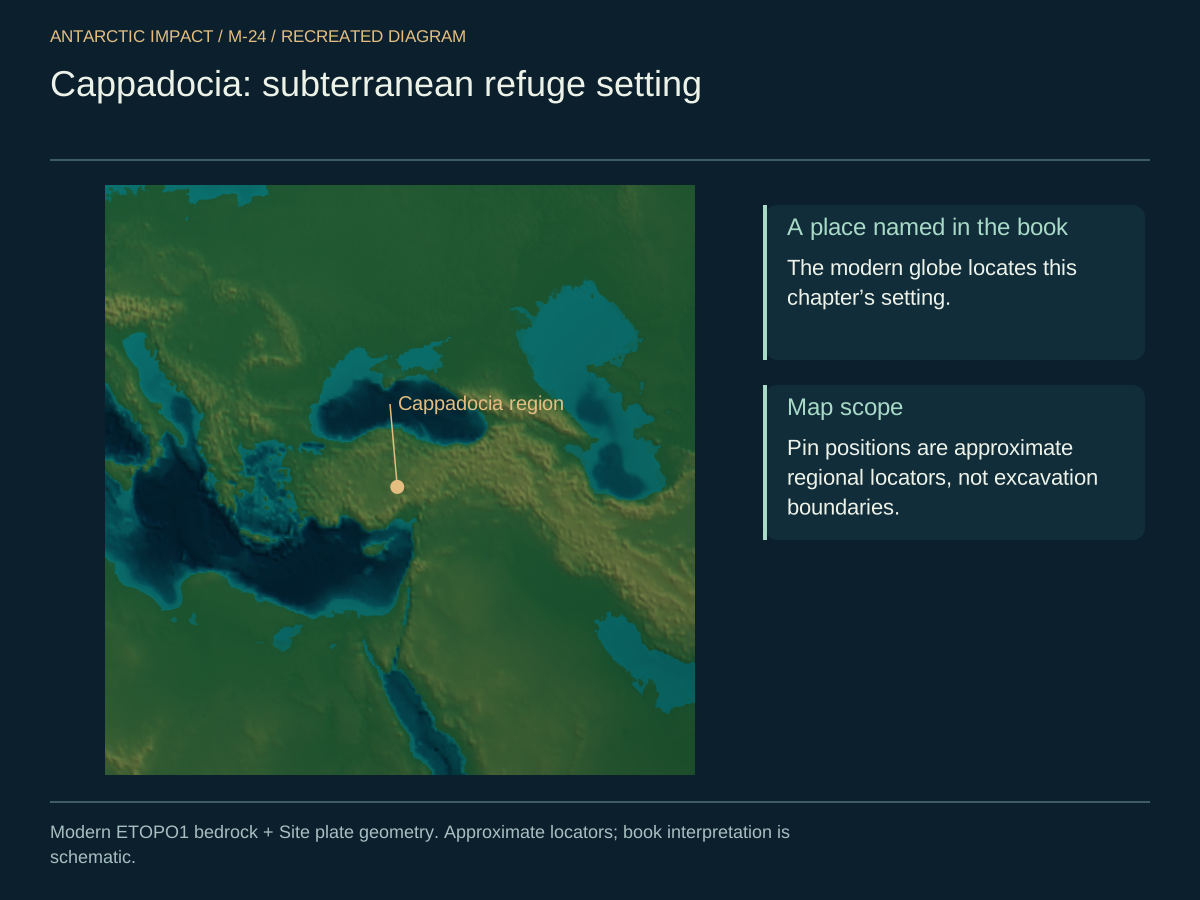
And here is the schematic — Cappadocia as the engineering model. Ventilation shafts, water cisterns, food stores, multi-level chambers. The mechanics of long-term sheltering are not science fiction. They are something late-Paleolithic and early-Neolithic peoples could do, given motivation.

The Underground Sanctuary Scenario
Picture, for a moment, what a prepared culture would have done in advance of a known threat. Caves and excavations dressed up, expanded, stockpiled. Food stores of dried meats, nuts, grains. Water cisterns and filtered springs. Ventilation shafts and indirect light wells. The mechanics of long-term sheltering are well within the engineering capacity of late-Paleolithic and early-Neolithic peoples, given motivation. Add a generation or two of advance warning — and the comet swarm we are describing, viewed against the dark sky over months and years, provided exactly that warning — and the scenario writes itself.
The emergence is the other half. Coming back up. Blinking into a transformed world. Rebuilding above ground while remembering — encoding the memory, in song, in image, in ceremony — what was lost and what was kept. The "going-back-up" archetype that runs through the world's resurrection myths is the cultural residue of an actual emergence.
Survival Strategies
- Groups that recognized the impending disaster retreated underground, building bunkers, caves, or entire subterranean networks to ride out the cataclysm.
- After conditions on the surface stabilized, these underground enclaves emerged, rejoining or overshadowing survivors who had lived through the chaos above ground.
These underground dwellers became the sources of the world's myths about advanced beings, visitors from the sky, and elusive civilizations.
Advanced Remnants
Humans who went underground preserved more advanced knowledge and technology than those forced to survive in harsh surface conditions. Over generations, the two groups diverged:
Surface Dwellers
- Grappling with shattered ecosystems and extreme weather
- Rebuilding slowly, using simpler methods
- Passing on myths and legends of a world-altering catastrophe
Subterranean Survivors
- Maintaining (and advancing) scientific and engineering capabilities
- Emerging only after the planet stabilized
- The source of the "star people" and "inner-earth" traditions
Go with us here, because this is where we commit. The oral histories from around the world — "star people," "ants," "inner-earth" civilizations guiding surface humans after a world-ending event — line up too cleanly with the impact-survival physics to be decoration. Humanity came out of the Younger Dryas as two distinct lineages that diverged during the long sheltering period and then re-entered each other's world during the rebuild. The surface lineage carried the memory of the sky falling and the sea rising; the subterranean lineage carried the practical knowledge of how to survive that. When the dust cleared, they met again — and the meeting is what every "knowledge-bringer" myth across the planet is remembering. The rocks carry the impact; the myths carry the meeting. Humanity did not walk this off as one population. Two lineages, two memories, one meeting.
The Great "Knockout"
During the comet impact, the pressure wave and the sound from atmospheric collapse were so powerful that they knocked every living creature unconscious — at least momentarily. When humanity "woke up," we found:
- Altered Landscapes: Continents newly separated by oceans, mountains towering where plains once stood.
- Extreme Climate Shifts: Rapid sublimation of cometary nitrogen ice generated sauna-like conditions in some regions, hastening the melting of snow and ice — alongside nitric acid rain and choking dust.
- Drowned Coasts: The pre-impact world's coastal heartlands — Sundaland, Sahul, Beringia, Doggerland — were going under, and would keep going under for generations.
- Cave and Shelter Life: Those who survived above ground sheltered in caves or holes, emerging to rebuild their lives over generations.
This collective revival — our "resurrection" — forms the heart of countless myths celebrating new growth, rebirth, and renewal.
Symbols of Renewal
The chapter title, "The Resurrection," also alludes to familiar springtime imagery: green grass shooting up, rabbit populations flourishing, eggs symbolizing rebirth. Many cultures celebrate versions of Easter, the spring equinox, or other festivals that mark nature's return to life after winter's dormancy.
Look at the world's resurrection traditions side by side and the convergence is striking. Christianity has Easter — death, descent, and rising. Egypt has Osiris, dismembered and reassembled, a god of the dead who returns. Greece has Persephone, who descends each year and is recovered each year, her absence the winter and her return the spring. Hinduism has its cyclical cosmology: destruction and renewal as a built-in feature of the world's rhythm. Norse mythology has Ragnarök — the world's ending, and a quiet repopulation by survivors afterward. These are not the same story. They are the same shape: a catastrophe, a sheltering, and an emergence.
Draw the convergence as a network and the shape becomes unmistakable. Mesopotamia, Hebrew, Greek, Hindu, Mesoamerican, Chinese — cultures with no plausible mechanism of contact, all carrying flood-and-sky-fire-and-lost-world myths in convergent form. The connection is the argument.

The Egg
The egg motif deserves a paragraph of its own. The cosmic egg, the world egg, the Easter egg — emergence from a sealed enclosure into open air — turns up across cultures, in creation myths, in renewal festivals, in seasonal markers. It is, very precisely, the imagery of going underground and coming back out. Not every egg in human ritual descends from the impact; but the impact is the obvious source for a symbol that recurs in so many places, in so similar a shape.
These renewal symbols run deeper than the changing of seasons. They are an ancient, planet-wide memory of humanity's post-impact survival and the world's regeneration under warmer skies.
Reflecting on the Present
Here we are, in the year 2025, pondering the extent of our cosmic vulnerability. Space exploration has shown us that catastrophic impacts are not far-fetched. Our ancestors went through a life-altering collision around fifteen thousand years ago. How should we respond today?
- Mature Perspective. Humanity is finally ready to confront the idea that we have endured global cataclysms before — and could again.
- Collective Memory. Knowledge of our past survival empowers us to prepare for future cosmic hazards.
- Global Cooperation. After the impact, cooperation was essential for survival. Recognizing our shared vulnerability can unite us in the face of future threats.
A Maturity Threshold
Something quietly remarkable happened in the last decade. For the first time in human history, the two halves of a planetary-defense capability arrived in the same generation. On the detection side: Vera Rubin / LSST and JWST give us, between them, a credible chance of cataloguing most impactor-class objects approaching the inner solar system. On the deflection side: NASA's DART mission demonstrated, at proof-of-concept scale, that a kinetic impactor can measurably alter the trajectory of a small body in space.
We do not yet have, in operation, the infrastructure to defend the planet. We do have, for the first time, the components. 2025 is the maturity threshold in this sense: we now know we can do it. The question is whether we will.
What We Do With It
If this has happened before, it can happen again — and the response begins with looking. Sustain the Rubin/LSST campaign. Keep JWST time for outer-system candidates. Build out southern-hemisphere infrared survey capability, so that the direction the swarm came from is the direction we watch most closely. Make the catalog as complete as it can be, as fast as it can be.
Detection is half a capability. Carry kinetic-impactor work past the DART demonstration into a deployable system; continue gravity-tractor research alongside it. And for the impacts that cannot be turned aside, keep the shelters. The underground and hardened infrastructure that already exists for other purposes should be maintained, not forgotten; our ancestors survived because they had somewhere to go.
None of this works inside a single nation. The threat is planetary, and the response must be planetary. These are not exotic measures — they are extensions of work already underway. What they require is the decision to take our own history seriously.
Conclusion
The resurrection of humanity following a massive comet impact is a central theme that pervades myth and cultural memory. We reawakened to a drastically altered planet, rebuilding our civilizations from a handful of survivors — some hidden beneath the Earth, others wandering the ruined surface. Our symbols of rebirth and renewal are echoes of that ancient struggle.
The difference between our ancestors and us is not in the size of the threat. It is in our position to do something about it. We have a choice they did not — to prepare, to survive not by accident but by design.
As we look to the future, we must ask ourselves: what lessons have we truly learned from this cataclysmic past? And how will this knowledge shape our response to the ever-present possibility of cosmic upheaval?