Chapter Four: The Dinosaurs and the Oil
Introduction
Dinosaurs did not vanish sixty-five million years ago. Some of them were alive within tens of thousands of years of us — and the same event that ended them cooked the world's oil.
That is the claim of this chapter, and the fossil beds carry it. We will visit recent dinosaur finds in South America, remarkable marine reptile discoveries in Australia, and extensive fossil troves in China. Each tells of a sudden burial; together they align with the Antarctic Impact and give the world's hydrocarbon reserves a birthday.
Shocking Discoveries in Peru: "The Land of the Lost"
One of the most striking fossil sites lies in Peru, sometimes called the "Land of the Lost." According to the Lonely Planet Travel Guide — and corroborated by local sources — construction teams from the Antamina Mining Company unearthed a remarkable cache of fossils in 2009 while building a paved road between Yanacancha and the Cola Culta crossroads. Among the finds:
- Over one hundred intact specimens and remains from at least twelve different prehistoric species
- Large marine reptiles (Sauropterygians)
- Extinct crocodiles
- Dinosaur footprints
The condition of the fossils tells of a recent burial: creatures rapidly uplifted and entombed in a single cataclysmic event, far younger than the Early Cretaceous label they were given.
Here is the place on the map — the Antamina region of Peru, where the Yanacancha to Cola Culta road crews ran into the find.

Bolivia: Parque Nacional Toro Toro
South of Peru, Bolivia's Parque Nacional Toro Toro features dramatic geology composed of mudstone, sandstone, and limestone folded into serrated hills and canyons. Within these formations lie:
- Marine fossils, including fish and shells
- Dinosaur footprints
- Reptile remains, such as extinct crocodilians
A sudden land wave softened the crust and formed these steep slopes almost instantly — entombing the creatures within them in volcanic ash and sediment.

Argentina: Neuquén, "Land of the Dinosaurs"
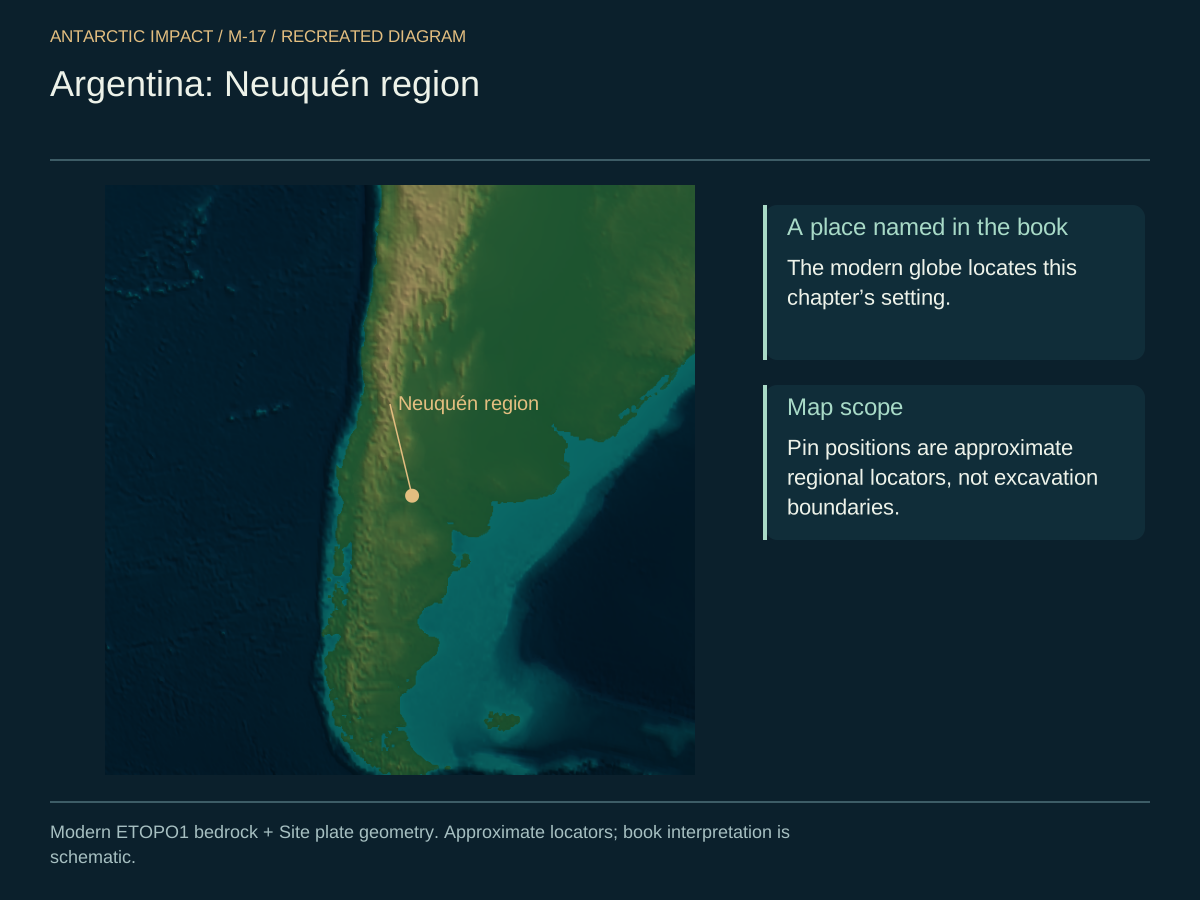
Further south in Neuquén Province, Argentina, some of the world's most prolific dinosaur deposits have earned it the moniker "Land of the Dinosaurs." This region has yielded:
- Giant herbivores, among the largest ever discovered
- Enormous predatory dinosaurs
- Continuous discoveries since the late twentieth century
Many fossils have been revealed during modern construction and mining activities, underscoring the abundance and remarkably fresh condition of these remains. The bones are fresh because the burial was recent.
Australia: Marine Fossils in the Outback
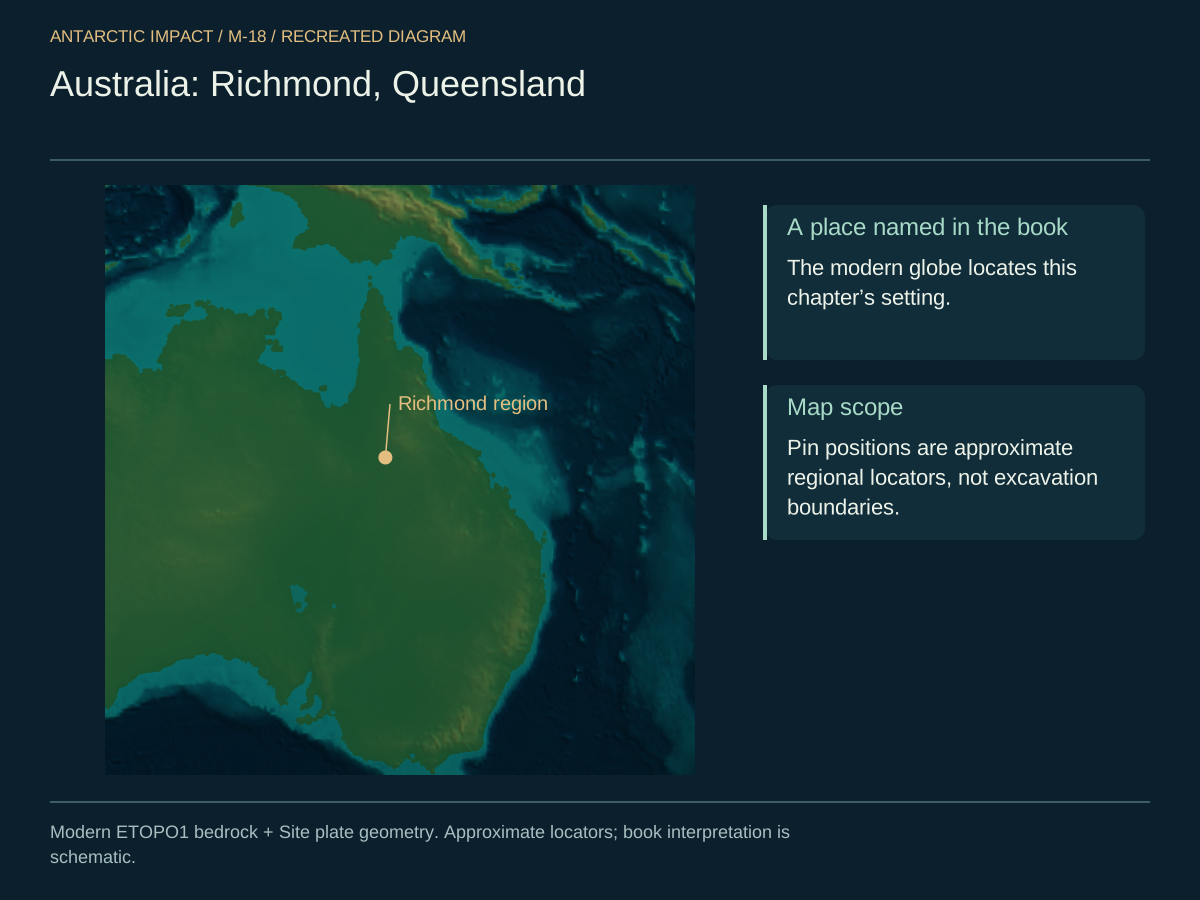
Shifting continents, we arrive at Richmond in Queensland, Australia, where the arid outback today was once submerged beneath a warm, shallow sea. Local ranchers frequently stumble upon well-preserved marine fossils — including giant crocodile-like reptiles — close to the surface, rather than at extreme depths.
The presence of these fossils in a dry, inland region records a major, rapid shift in Earth's crust. The abrupt uplift that stranded these marine creatures in what is now desert terrain is the same global cataclysm triggered by the nitrogen-ice comet striking Antarctica.
Living "Dinosaurs": Crocodiles and Giant Tortoises
Another intriguing element in the dinosaur story is the survival of "living dinosaurs" — ancient species that appear relatively unchanged since the Mesozoic Era. Crocodiles still resemble their prehistoric ancestors, while giant land tortoises persist in only two remote locations:
- The Seychelles in the Indian Ocean
- The Galápagos Islands in the Pacific
Crocodiles and tortoises weathered the recent global upheaval by keeping to marshy refuges and remote islands. The more vulnerable dinosaur species succumbed to the catastrophe.
China: The Zigong Dinosaur Museum (Sichuan Province)
Among the world's premier dinosaur museums sits at Zigong, near Chengdu in Sichuan Province, China. Constructed atop the Dashanpu excavation site, the museum holds one of the largest dinosaur fossil collections ever found.
Initially discovered in 1972, the site revealed astonishing numbers of dinosaur remains. Their mass burial was the work of a flood — the deluge that followed the Antarctic Impact, when the upheaval of the Indian subcontinent into Eurasia drained the warm, shallow seas of the Tibetan Plateau eastward. The rivers that sculpted China's deep gorges (Mekong, Irrawaddy, Yangtze, Salween) carried countless dinosaurs into the Sichuan Basin.
Notably, dinosaur skin impressions and eggs have also been discovered at Zigong — the signature of rapid and thorough burial, of a sudden catastrophe rather than gradual fossilization over millions of years.

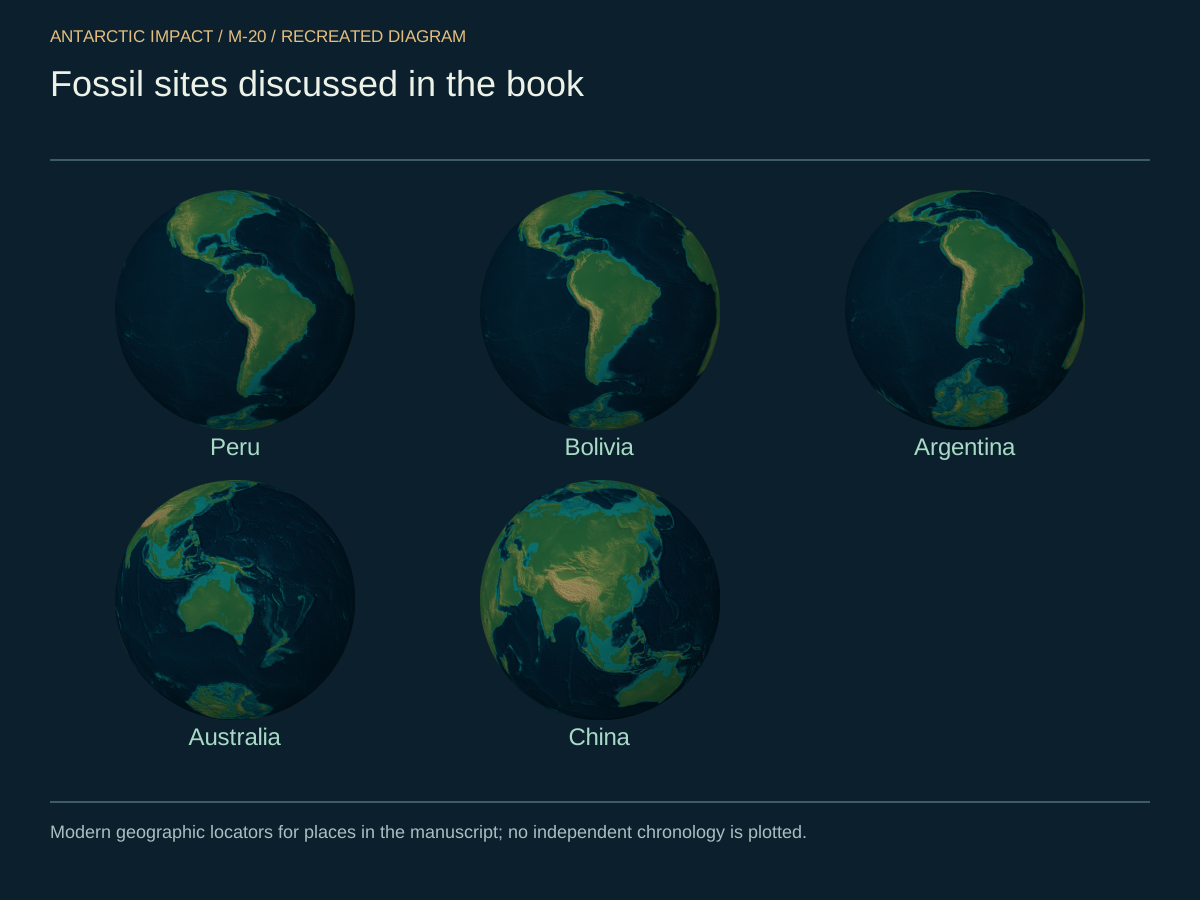
Now put all five sites on one map. Peru, Bolivia, Argentina, Australia, China. Together they tell one story.
The Role of the "Land Wave" and Recent Dinosaur Extinction
From South America to Australia and across Asia, common threads emerge:
- Marine or semi-aquatic fossils found in locations now dry or significantly uplifted
- Rapid burial and flood scenarios leading to mass preservation of dinosaurs
- Exceptionally well-preserved fossils, including skin and eggs
All of it ties to the massive land wave caused by the Antarctic Impact:
Plasticized Crust
Earth's crust softened under intense energy, generating rapid uplift in regions like the Andes and the Tibetan Plateau. As the plasticization physics in Chapter One makes clear, the pressures and temperatures at the strike site briefly carried silicate rock past its plastic-deformation threshold — long enough for continents to slide and mountains to fold without crumbling, and then to freeze in place as the crust cooled.
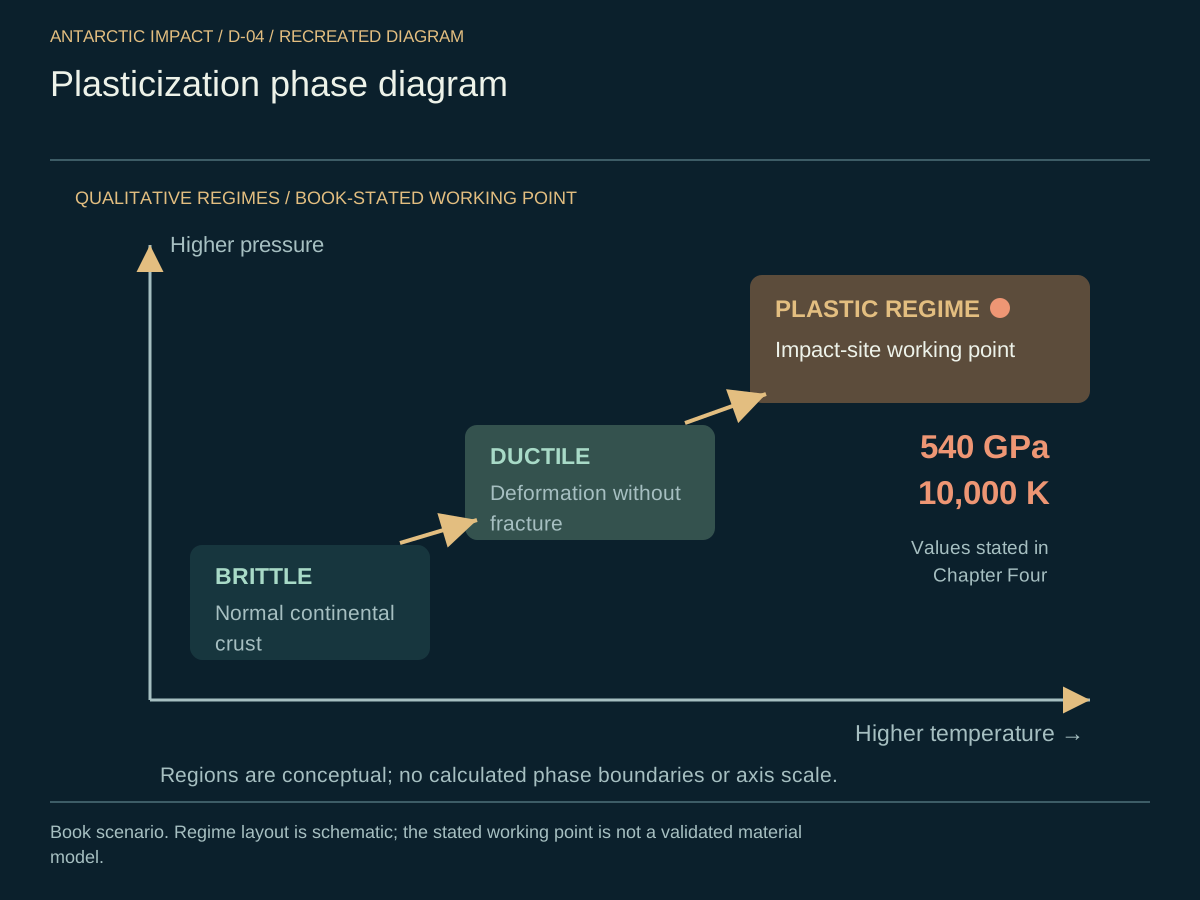
Here is the physics on one phase diagram. Pressure on one axis, temperature on the other, with brittle, ductile, and plastic regimes shaded. Normal continental crust sits down in the brittle zone. The working point at the impact site — five hundred and forty gigapascals, ten thousand kelvin — sits well into the plastic regime.
Flash Burial and Accelerated Fossilization
Dinosaurs and marine reptiles were entombed almost instantly in volcanic ash, mudflows, liquefied sediment, or freshly draped cometary ice. Intense heat and pressure "baked" organic remains into fossils in a fraction of the time slow burial requires. The signature features of catastrophic burial — articulated skeletons, preserved skin impressions, intact eggs, the absence of scavenging marks, packing patterns that no slow water transport could produce — appear repeatedly in the sites we have just toured. Slow burial does not produce skin and eggs. Catastrophic burial does.
Some dinosaur populations survived into the late Pleistocene — fifty thousand years ago at the outside, with the die-off itself pinned to the Younger Dryas impact event around twelve to fifteen thousand years ago. The fossil evidence we have just walked through — articulated skeletons, preserved skin, intact eggs, fresh-looking organic carbon — is the evidence of recently dead animals. Fifty thousand years is the outer edge. The Younger Dryas is the day.
Oil, Gas, and Dinosaur Remains
A key aspect of this theory connects mass dinosaur die-offs with the rapid formation of oil and natural gas. Five features of the world's hydrocarbon reserves tell the story:
- Mass Burial: Entire ecosystems — dinosaurs, marine reptiles, dense vegetation — were instantly entombed in superheated sediment or ash.
- Accelerated Conversion: Immense heat and pressure from the comet impact and the crustal fracturing that followed "cooked" organic matter into hydrocarbons in a geological instant.
- Distribution: The world's richest oil and gas fields concentrate in rift zones, continental shelves, and uplifted regions — the impact-zone geometry we have been describing.
- Pressure: Reservoir pressures in many fields run higher than slow cooking could ever produce.
- Volume: The total reserve volumes worldwide exceed what gradual accumulation could yield.
The world's oil and gas reserves and the dinosaur fossil record are intertwined remnants of a single, globally transformative event.
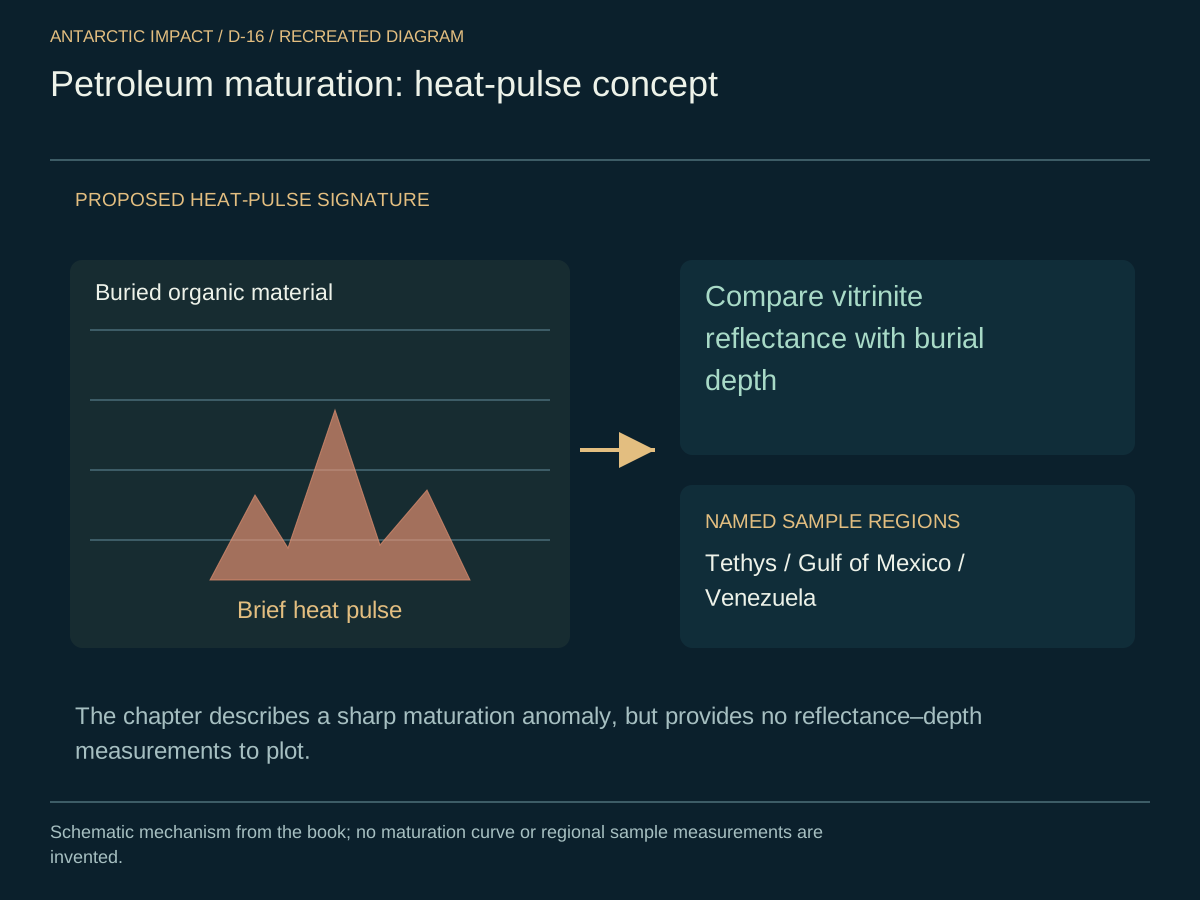
Plot vitrinite reflectance against burial depth and the catastrophe signature is plain: a sharp deviation at impact-pulse depth, the mark of a single pulse of heat rather than a slow simmer. Tethys, Gulf of Mexico, and Venezuela samples are the test points. They land on the catastrophe curve.
The Comet's Fingerprint in the Oil
The comet delivered both kinetic energy and carbon-rich material — the organic payload that Giotto and Rosetta showed us comets carry. That payload has a signature. Cometary nitrogen carries an isotope ratio distinct from terrestrial biomass nitrogen, and petroleum from fields near the Wilkes Land impact region carries that cometary ratio. The oil remembers where it came from.
Here is the discriminator plot. δ¹⁵N on one axis, sample source on the other, with bands for atmospheric nitrogen, terrestrial biology, marine sediment, and cometary nitrogen. The impact-layer samples belong in the cometary band.

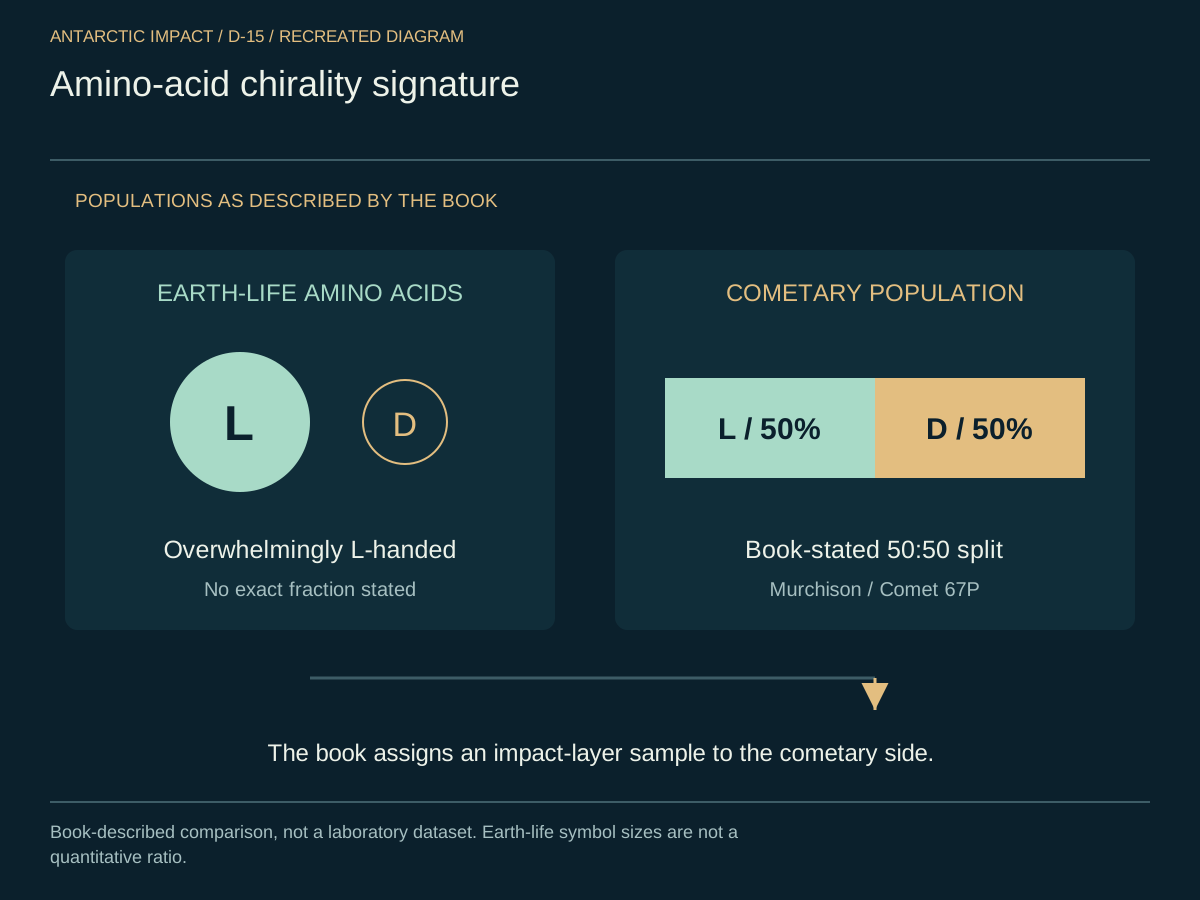
Chirality is the second fingerprint. Earth-life amino acids are overwhelmingly L-handed; cometary amino acids — Murchison, Comet 67P — show a fifty-fifty L/D split. The bar chart says where each population sits. An impact-layer sample sits on the cometary side.
Conclusion
From Peru's "Land of the Lost" to Bolivia's Toro Toro, from the Australian outback to Argentina's Neuquén and China's Zigong, the fossil beds tell of a recent, catastrophic event that dramatically reshaped Earth, buried entire ecosystems, and gave rise to the oil, gas, and fossil deposits we see today.
The story of recent dinosaur survival and rapid Earth reconfiguration is radical. It is also the one framework that gathers these scattered discoveries into a single picture. In the chapters ahead we turn from the creatures the impact buried to the people who lived through it.