Chapter Six: The Origins of the Comet Swarm
Revisiting Solar System Cratering
In earlier chapters, we described how a wave of cometary impacts — occurring roughly thirteen to fifteen thousand years ago — peppered the solar system and reshaped Earth's surface. A recent comet swarm, not a bombardment four billion years gone, is responsible for many of the great impact sites on the Moon, Mercury, Mars, Earth, and elsewhere.
Which means crater counts tell a different story than has long been assumed. A heavily cratered surface is not necessarily an ancient one. Much of the cratering we see is the residue of a single, recent season of violence.
The 18–23° Inclination Mystery
A recurring motif in our work has been the eighteen-to-twenty-three-degree angle:
- Pluto's Orbit: Pluto's orbital inclination is about seventeen to eighteen degrees relative to the ecliptic.
- Mars's Axial Tilt: Approximately twenty-five degrees, close to Earth's twenty-three and a half — a shared influence.
- Extreme Trans-Neptunian Objects (ETNOs): Many have orbits inclined around eighteen degrees, including the named members of the cluster — Sedna (90377) and 2012 VP113, the two most-cited objects whose inclination clustering is the empirical anchor for the Planet Nine hypothesis.
We see this angular range repeatedly across celestial bodies. This is no coincidence. It is the fingerprint of an external force — a large, distant planetary body — that pulls comets and minor planets into these inclined orbits.
Here is the histogram. Orbital and axial inclinations across Earth, Mars, Pluto, and the ETNO cluster, plotted on a single chart. The convergence around eighteen to twenty-three degrees is the kinematic signature — the fingerprint of a common gravitational influence.

The Planet Nine Hypothesis
The inclined comet swarm has a shepherd: Planet Nine. Astronomers, most prominently Konstantin Batygin and Mike Brown, have proposed an undiscovered planet — sometimes called Planet X — with parameters in roughly the following range:
- Mass: five to ten Earth masses (Batygin and Brown's canonical figure).
- Semi-major axis: four hundred to eight hundred AU.
- Orbital period: ten thousand to twenty thousand years.
This is a smaller, more constrained object than the "Neptune-class" estimates of a decade ago, and it sits comfortably within the gravitational constraints required to herd the ETNOs into their observed inclinations.
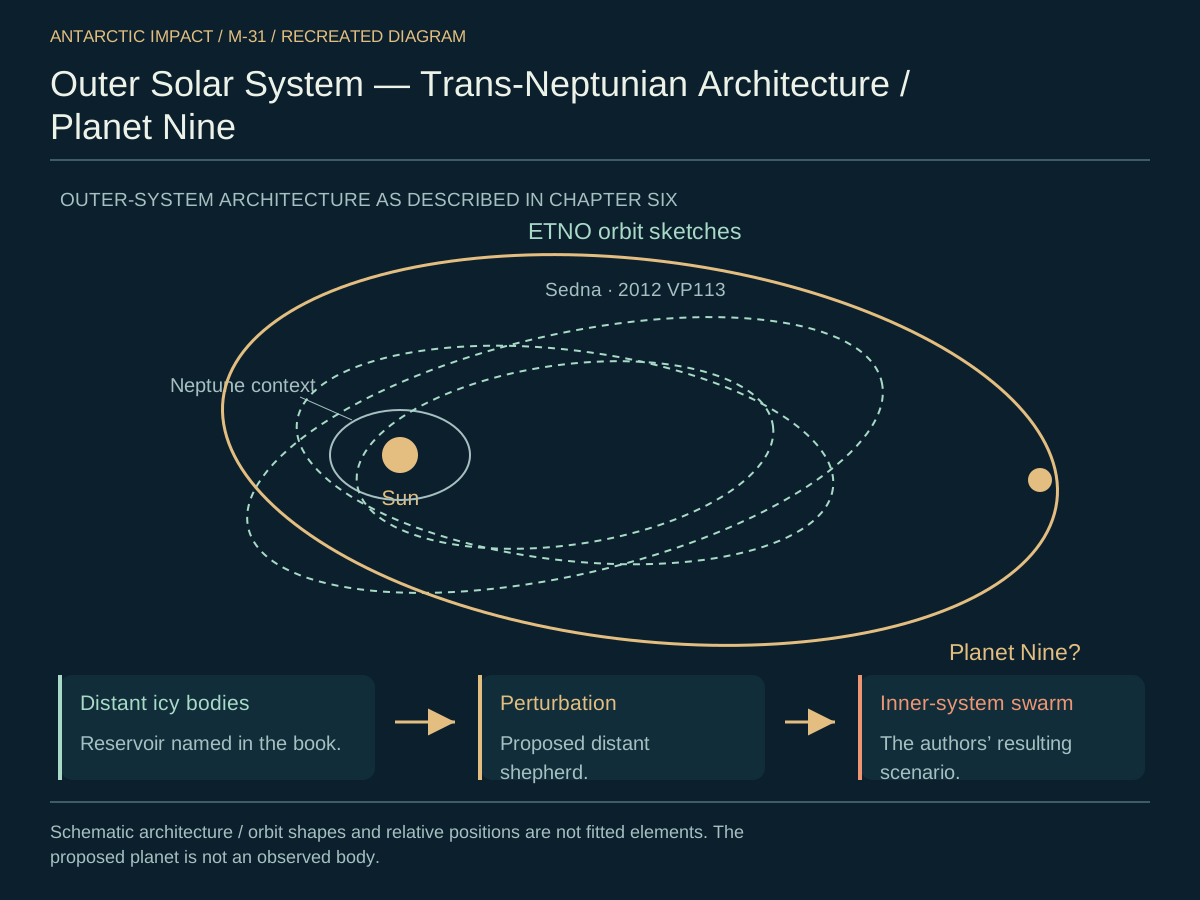
Picture the outer solar system architecture in one view — Neptune's orbit, the ETNO cluster, and the long-period Planet Nine loop sweeping out beyond all of it.
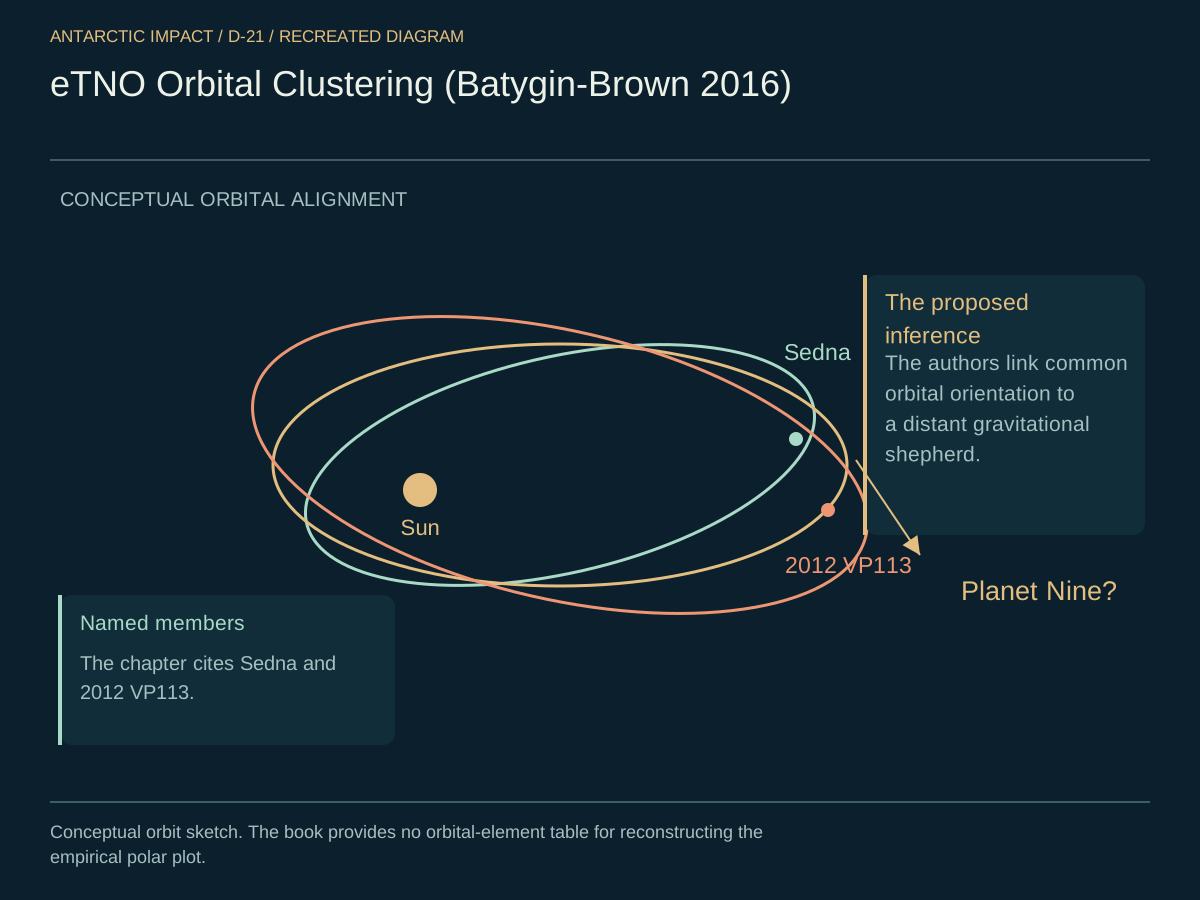
And here is the empirical anchor — the Batygin and Brown polar plot. The ETNO orbits, plotted in argument-of-perihelion vs. inclination space, cluster in a way that random distribution does not produce. That clustering is the gravitational signature that started the modern Planet Nine search.
The orbit itself — long, elliptical, inclined — looks like this.

- Long Elliptical Orbit. Planet Nine loops far beyond Neptune in the remote reaches of the solar system on the multi-millennial cycle named above.
- Gravitational Perturbations. ETNOs, including Sedna and 2012 VP113, cluster at certain angles — the work of a massive, distant planet whose gravitational pull "herds" these objects into roughly the same orbital alignments.
- Approach from the South. When Planet Nine nears the inner solar system, it does so from a southward inclination of about eighteen to twenty-three degrees. Passing through the plane of the ecliptic, it drags a swarm of icy bodies — comets and other debris — along in its wake.
- Slingshot Effect. As Planet Nine makes its closest approach and then arcs back outward, it flings these comets into the inner solar system, causing widespread bombardment. That is the origin of the crater-rich landscapes of so many planetary surfaces, including Earth's.
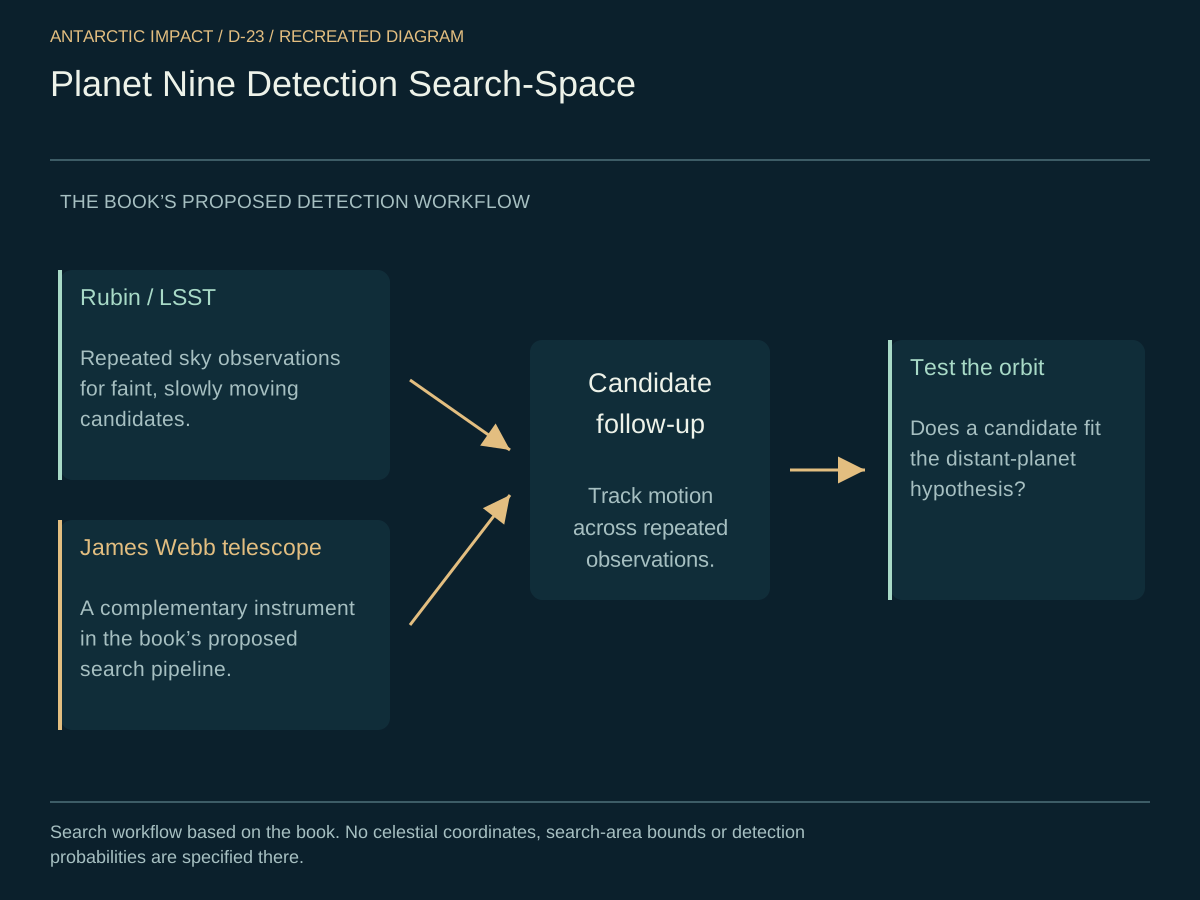
Planet Nine has not yet been seen. But the Vera C. Rubin Observatory in Chile — with its Legacy Survey of Space and Time (LSST) — and the James Webb Space Telescope together form a detection pipeline more capable than anything astronomy has previously had at this task. Faint, slow-moving objects in the right orbital zone are now within reach.
Cometary Ice: A Galactic Perspective
A natural question arises: where does all this ice come from? The solar system — especially at its outer edges — hosts countless fragments of frozen material.
- The Oort Cloud and Beyond. Beyond Neptune lies the Oort Cloud, a vast shell extending up to a light-year from the Sun and filled with trillions of icy bodies. Any perturbation — a passing star, a galactic tide, the approach of a massive planet — can unleash these comets toward the inner planets.
- Galactic Weather Systems. Think of the galaxy itself as a dynamic environment, with vast molecular clouds, interstellar ice grains, and galactic-tide perturbations distributing ice, gas, and dust across star systems.
- Sublimation and Re-Accumulation. Large icy bodies — distant exoplanets or comets — lose mass through sublimation when passing near stars. Over eons, this vapor becomes part of interstellar clouds, later condensing again into icy fragments under the right conditions.
Water and ice arrive in waves across many star systems. Ours is one of them.
Timing and Future Discoveries
Planet Nine is likely near the far side of its elliptical orbit at present, too distant for easy observation. The Rubin/LSST and JWST pipeline will gather the data to find it — and, in turn, to trace precisely how the comet swarm entered the inner solar system.
Here is the search-space picture — the sky region where current constraints say Planet Nine must be hiding. The area is finite, the instruments are coming online, and the question is one we can settle in our lifetimes.
- Observation Challenges: Planet Nine is exceedingly faint and moves very slowly against the starry background, which is why it has stayed hidden this long.
- The Time Lag: Planet Nine has already swung by. Its gravitational "train" of comets may still be catching up or dispersing — a complex interplay that creates cascading bombardments long after the planet itself has receded.
Conclusion
A distant, massive planet with a steeply inclined approach is the key to the origin of the comet swarm that struck the solar system in the last twenty thousand years. Drawing porous, low-density icy bodies from the outer reaches, it hurled an array of cometary bodies inward, carving out craters on nearly every moon and planet in its path.
Moreover, the abundance of ice in our solar system — and throughout the galaxy — stems from large-scale "nebular weather patterns," ensuring that water and icy debris remain abundant across cosmic timescales. By rethinking the origins of comets, craters, and even planetary tilts, we invite new research into our solar system's recent and tumultuous past.
Key Points to Remember
- Recent Impacts. A comet barrage within the last twenty thousand years is responsible for much of the cratering we see today.
- Inclination Clues. Angles of around eighteen to twenty-three degrees consistently appear in planetary tilts and TNO orbits — the fingerprint of a unifying gravitational influence.
- Planet Nine. A massive planet on a ten-thousand- to twenty-thousand-year orbit slingshotted cometary material into the inner solar system.
- Galactic Weather. Water and ice circulate beyond individual star systems, feeding vast reservoirs in the outer solar system, primed for disturbance by passing cosmic bodies.
- The instruments to find it. For the first time in history, we have the telescopes to see the shepherd of the swarm. The next two decades will show it to us.