Chapter Three: Other Worlds, Other Impacts
Introduction
In the previous chapters, we described how a massive nitrogen-ice comet struck Earth, forming Antarctica, reshaping continents, and triggering an Ice Age roughly thirteen to fifteen thousand years ago. The story grows larger when we lift our eyes. Earth was caught in a hailstorm of nitrogen-ice comets, and a hailstorm does not strike one roof. Look across the solar system and the same recent violence is everywhere.
Mars with its Hellas Basin. The Moon with its South Pole–Aitken Basin. Mercury with Caloris. Pluto with Sputnik Planitia. Triton draped in nitrogen ice. Uranus knocked onto its side. The spongy, low-density moons of Saturn. Taken together, these are the record of a solar-system-wide event that dramatically reshaped world after world.
Mars: The Hellas Impact Basin
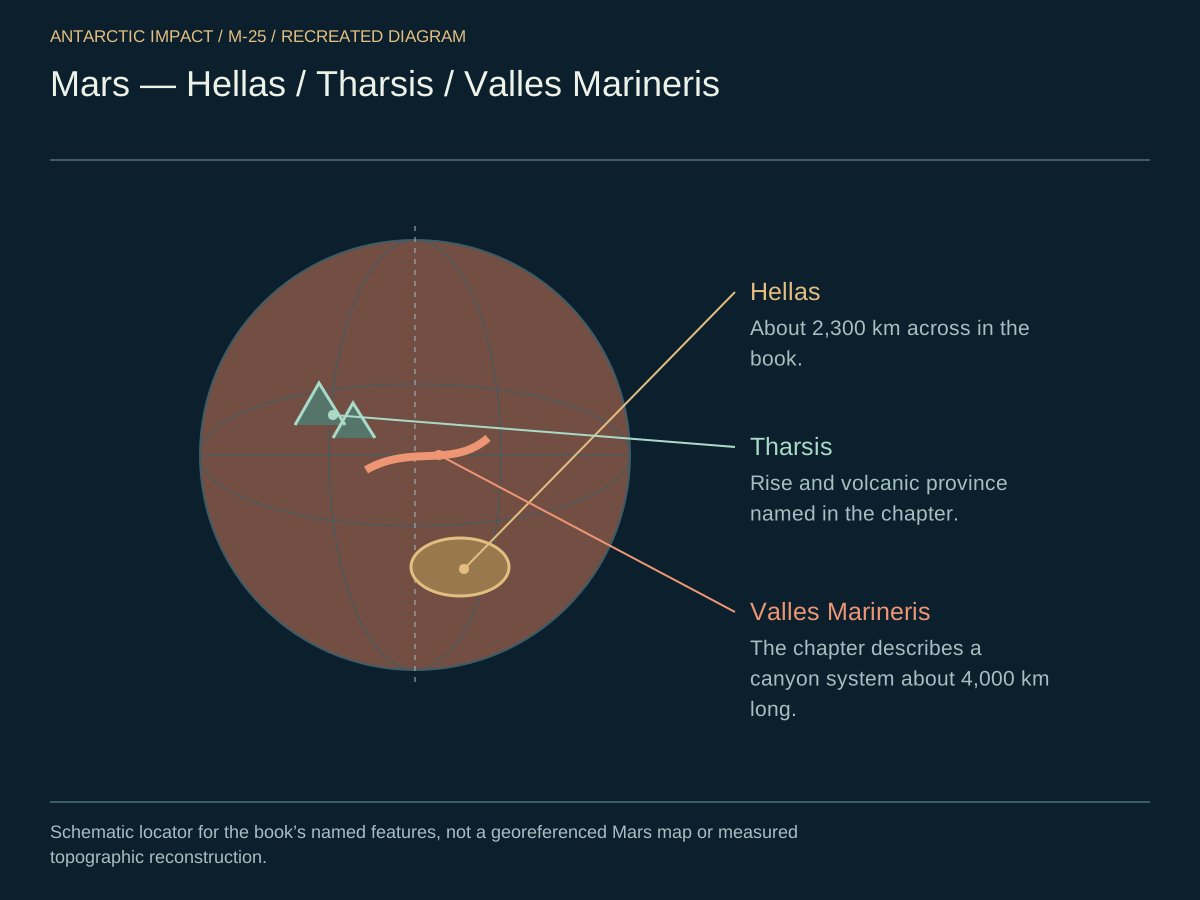
Here is the surface we are talking about — Mars with Hellas, Tharsis, and Valles Marineris in one view. The planet reads as a record of the same kind of event we have just described on Earth.
And here is the antipodal pair in schematic — Hellas as the strike point, Tharsis as the bulge on the opposite side. The same geometry we walked through for Earth, written into a different planet.
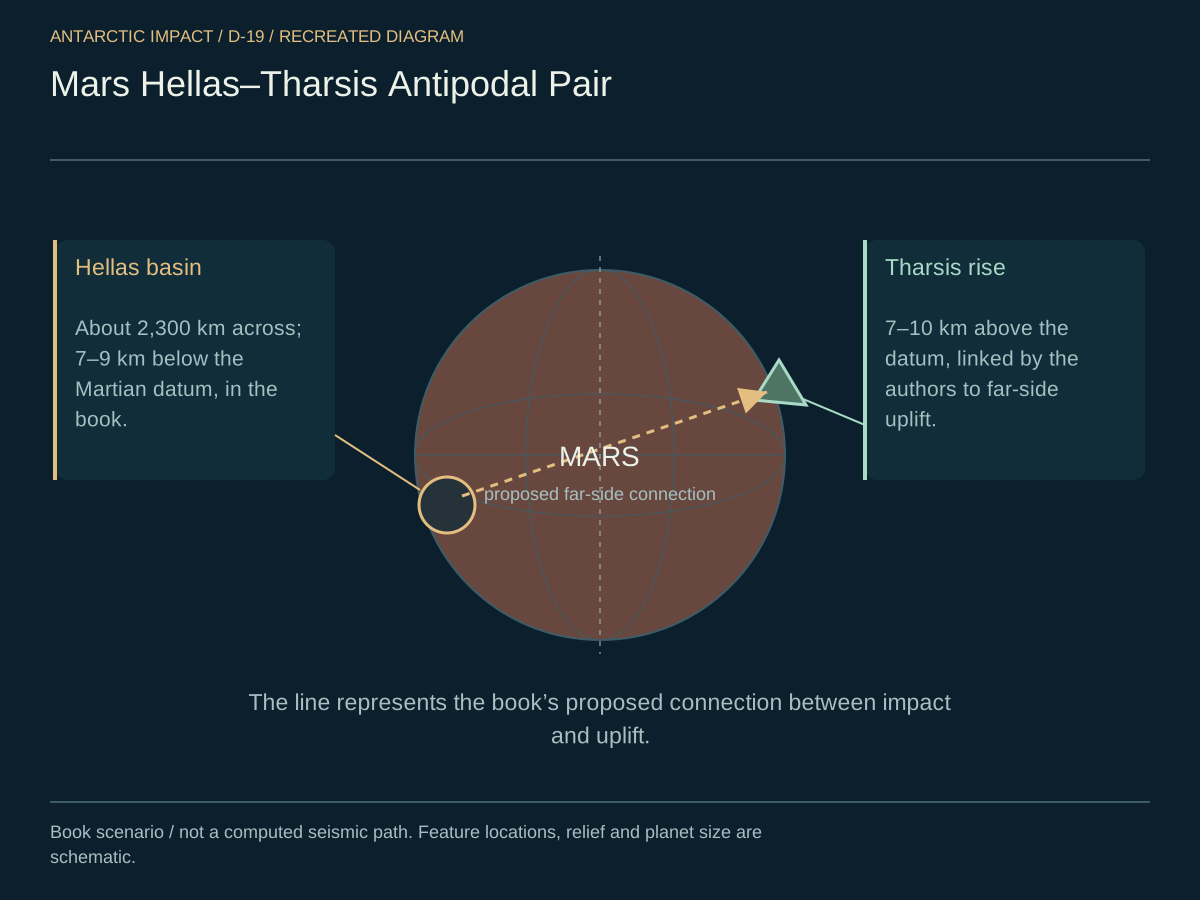
Among the largest impact craters in the solar system is the Hellas Impact Basin on Mars. Situated in the planet's southern hemisphere, Hellas spans roughly twenty-three hundred kilometers across, lies between seven and nine kilometers below the Martian datum, and is — by area — roughly the size of Antarctica.
- Comparable Scale: Hellas is similar in area to what became Antarctica on Earth. A comet of equal magnitude struck Mars.
- Glacial Evidence: High-resolution images from missions like Mars Express (ESA), Mars Global Surveyor (NASA), and the Mars Reconnaissance Orbiter (NASA) show glaciers inside Hellas, some still showing signs of movement beneath dust layers.
- Opposite Uplift: Directly opposite Hellas lies the Tharsis Rise, lifted some seven to ten kilometers above the Martian datum (roughly twenty-three thousand feet). This is no coincidence: the sheer force of the impact at Hellas thrust the far side of Mars upward. Tharsis hosts Olympus Mons, Ascraeus Mons, Pavonis Mons, and Arsia Mons — among the largest volcanoes in the solar system — the pressure vents of a planetary-scale collision.
- Valles Marineris: This colossal canyon system extends roughly four thousand kilometers long and up to seven kilometers deep, tracing a line from Tharsis toward Hellas. Immense floodwaters once surged through these canyons — the drainage of a crust heaved up in one motion.
- Timeline and Tilt: Mars's axial tilt of about twenty-five degrees and its twenty-four-hour day sit close to Earth's own. A comet barrage of this scale reinforced and refined Mars's present orientation, just as it set Earth's.
The freshest of these features date to thirteen to fifteen thousand years ago, not to millions or billions. Mars is the prime case study of how a cosmic impact can reshape a planet on timescales relevant to human prehistory — and it is the twin of what happened here.
The Moon: South Pole–Aitken Basin
The South Pole–Aitken Basin (SPA) is one of the largest, deepest impact features in the solar system — and it sits, almost perfectly, on the lunar south pole. That is not an accident.
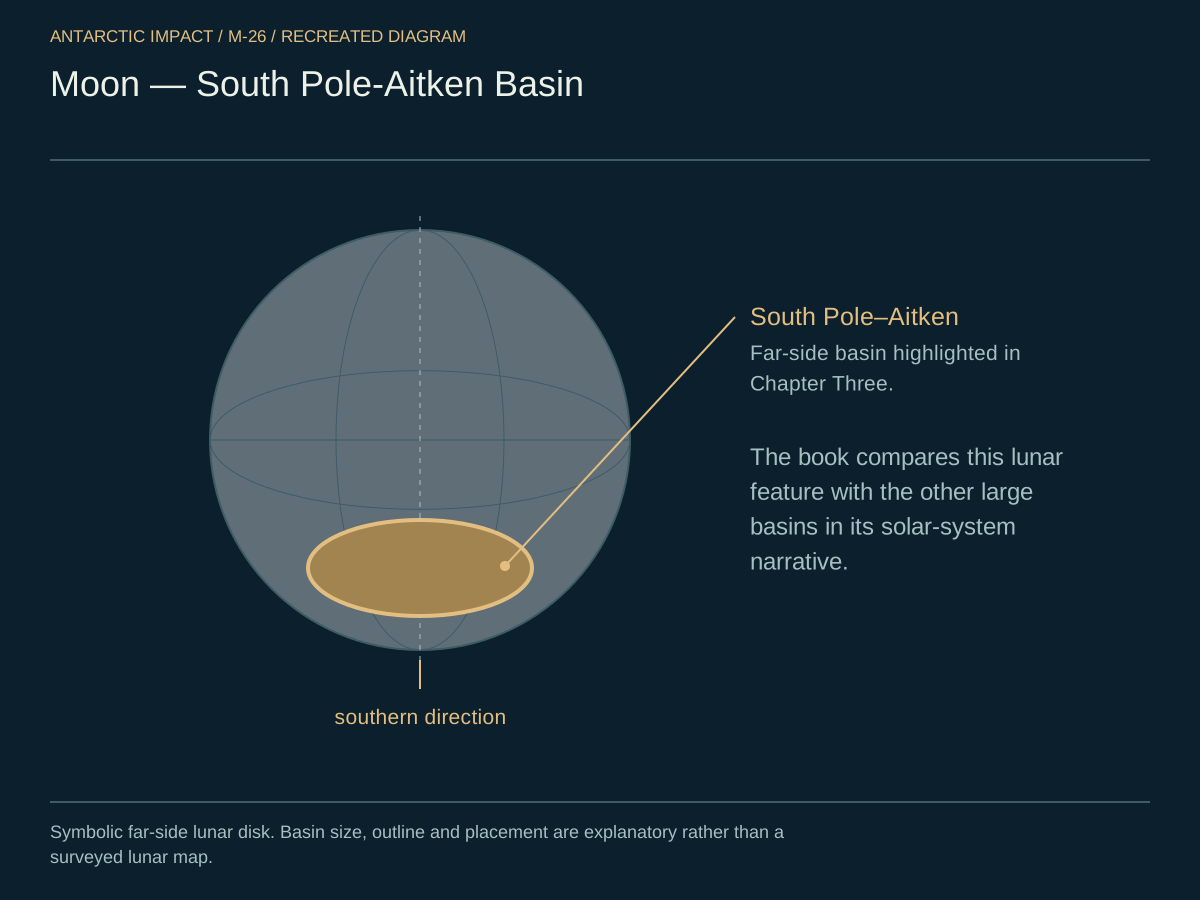
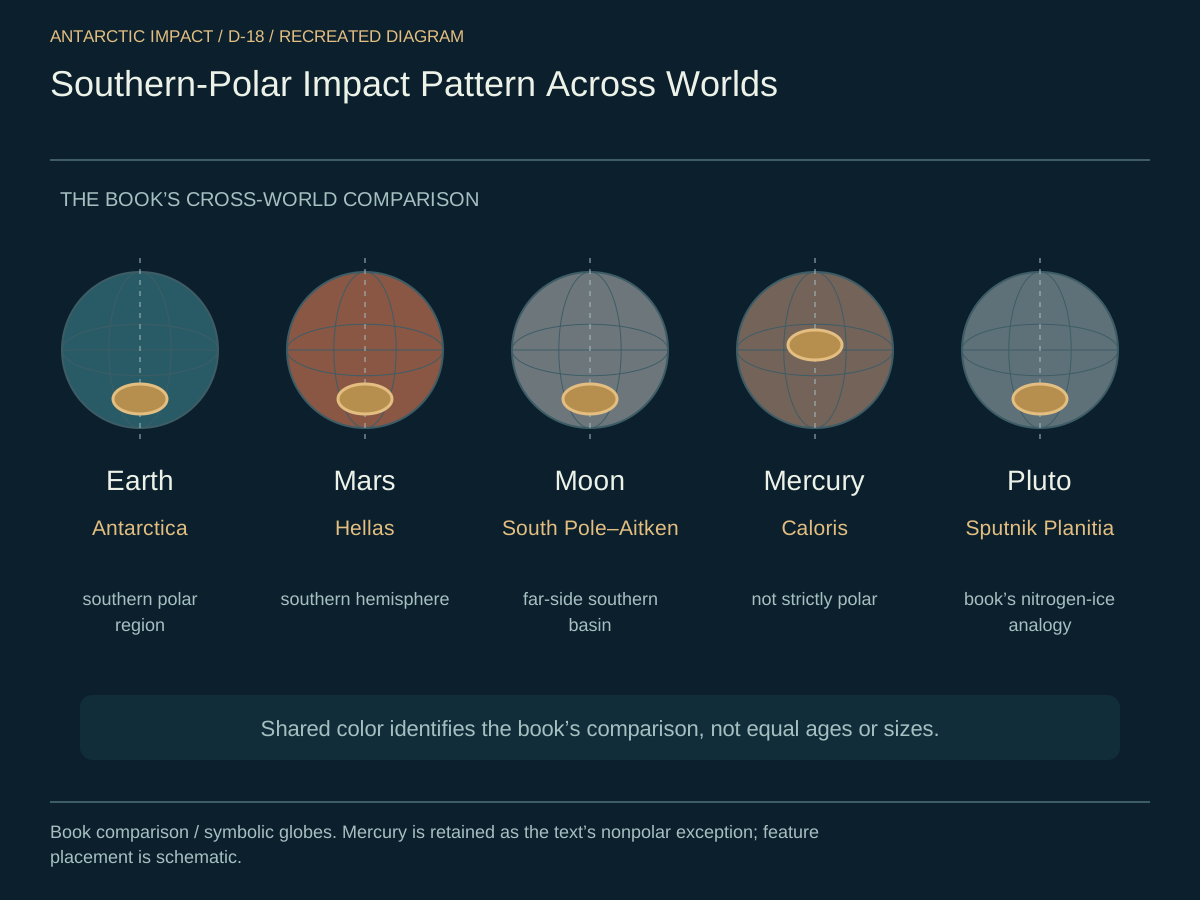
If impacts arrived randomly across the surface of a body, southern-polar concentrations would be rare. Instead the pattern repeats: Earth's impact at Antarctica, Mars's at Hellas in the southern hemisphere, the Moon's at SPA, Mercury's catastrophic basin at Caloris, and Pluto's at Sputnik Planitia. Five bodies. Five great basins. One direction of arrival.
Mercury: The Caloris Basin
Mercury's Caloris Basin, while not strictly polar, shares the catastrophic-impact character of the other great basins — broad, young, with jumbled antipodal terrain where the seismic energy of the impact converged on the far side of the planet and tore it up. Caloris tells us the swarm did not respect latitude everywhere. But where the great basins cluster, they cluster south.
Look at Caloris on Mercury, and at the chaotic "weird terrain" directly opposite — exactly where the seismic energy converged.

Pluto: A Nitrogen-Ice Surprise
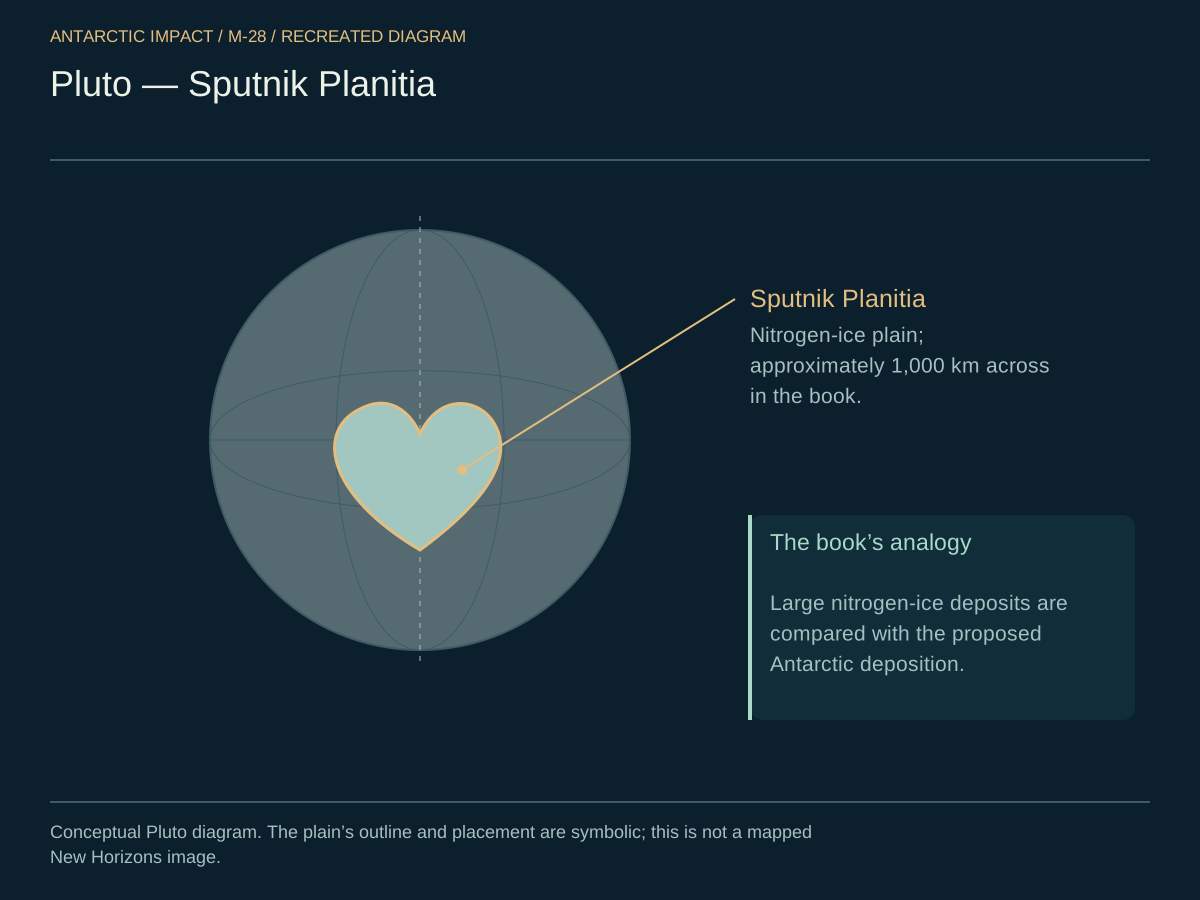
Traveling far beyond Mars, we encounter Pluto, whose unexpected wonders were revealed by NASA's New Horizons probe in 2015. Chief among them is Sputnik Planitia, a striking, heart-shaped plain of nitrogen ice, roughly a thousand kilometers across, in Pluto's southern hemisphere.
- Antarctica Analog: Covering an area comparable to a substantial fraction of Antarctica, Sputnik Planitia shows how vast deposits of nitrogen ice accumulate on a world.
- Cometary Link: Earth's Antarctica was laid down by nitrogen ice from a colossal comet; Pluto's nitrogen plains are the same process on a smaller body. Earth's atmospheric nitrogen came the same way — by cometary sublimation, the very process we watch on Pluto's surface today.
Sputnik Planitia reminds us that nitrogen ice is not rare in the outer solar system. A solar-system-wide barrage of nitrogen-ice comets left its imprint on world after world.
Here is the heart-shaped plain itself — Sputnik Planitia on Pluto, the nitrogen-ice surface that is the same kind of deposition that ended up under the East Antarctic ice sheet, only on a different body.
Triton: Neptune's Mysterious Moon
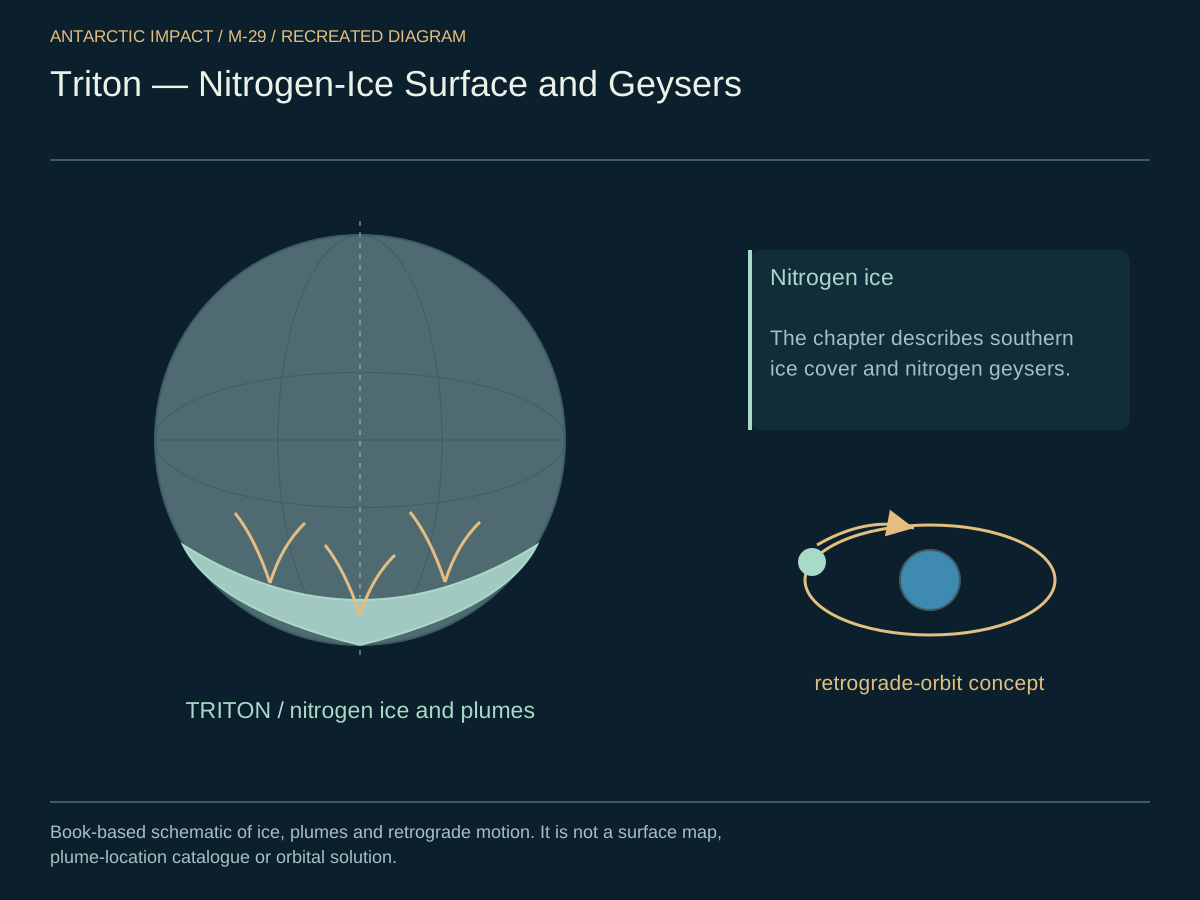
Moving on to Neptune, we encounter Triton — the largest of its moons and one of the coldest places in the solar system. Triton's entire southern hemisphere is coated in nitrogen ice, with nitrogen geysers erupting onto the surface.
- Retrograde Orbit: Triton orbits Neptune backward. It is a captured body — a visitor from the outer dark — and its nitrogen-ice surface is the residue of the same wave of cometary material that pummeled Earth.
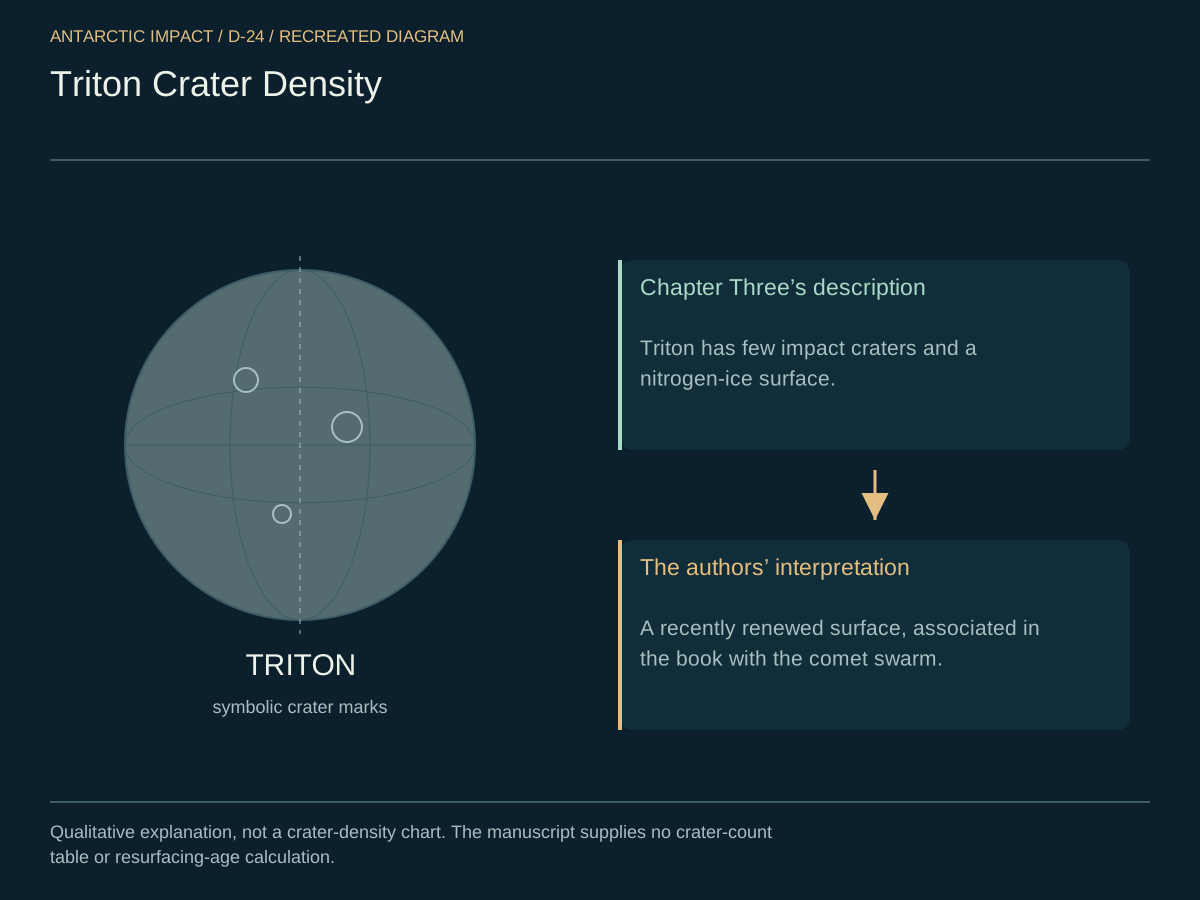
- A Young Surface: Triton shows few impact craters. Its surface was laid down in the recent past — within a window of a few tens of thousands of years, in step with the Antarctic impact.
Triton's blend of active geology and nitrogen ice shows how volatile cometary material shaped the far-flung corners of our solar system.
Here is Triton's surface — nitrogen ice draped across the southern hemisphere, with the geysers Voyager 2 first photographed in 1989.
And here is what makes Triton unmistakable. Stand it next to the other bodies on a crater-density chart and Triton is anomalously young. Something happened to it recently. That something was the swarm.
Uranus: The Planet on Its Side
Then there is Uranus, with its ninety-eight-degree axial tilt that causes the planet to orbit the Sun on its side. Uranus, too, was struck — a member of the same nitrogen-comet wave arrived with enough momentum to lay the planet over. The kinetic energy carried by a large cometary body leaves dramatic imprints on a world's rotation and orientation, and Uranus is the clearest case in the solar system.
Saturn: The Mystery of Hyperion (and Beyond)
Closer to the Sun lies Saturn, famous for its majestic ring system and a host of fascinating moons. One moon in particular, Hyperion, stands out:
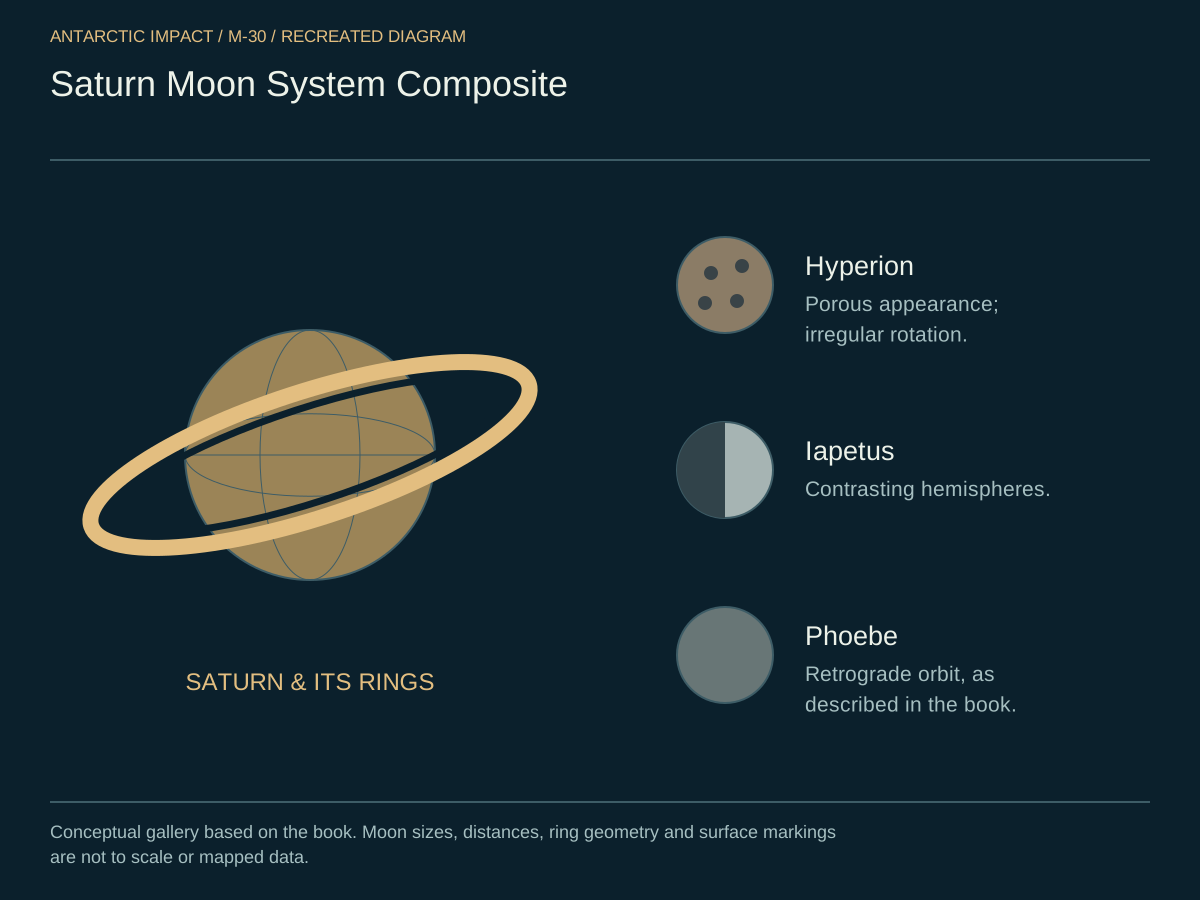
- Spongy Appearance: Hyperion's porous, low-density structure and erratic rotation evoke the image of a dirty snowball.
- Captured Fragment: Hyperion is a surviving member of the swarm. It came in retrograde, it came in eccentric, and it looks exactly like the kind of thing that struck Antarctica — only smaller, and captured rather than landed. Iapetus carries the same family resemblance from another angle: its stark two-toned face is the look of a body that has been hit hard by darker material from outside, the way the inner solar system was hit hard from outside. Taken together, Hyperion and Iapetus are the visible cousins of the body that made Antarctica — the kind of objects that survive when a portion of the wave is captured instead of impacted.
- Other Irregular Satellites: Saturn's family of irregular moons, including Phoebe (which orbits retrograde), are captured relics of the same cometary origin. Saturn's ring system itself was enhanced — and in part formed — by comet fragments shredded and dispersed into orbit around the planet.
Here is the whole Saturnian family in one view — the rings, Hyperion, Iapetus, Phoebe — the gallery of oddities that are the visible cousins of the body we are describing.
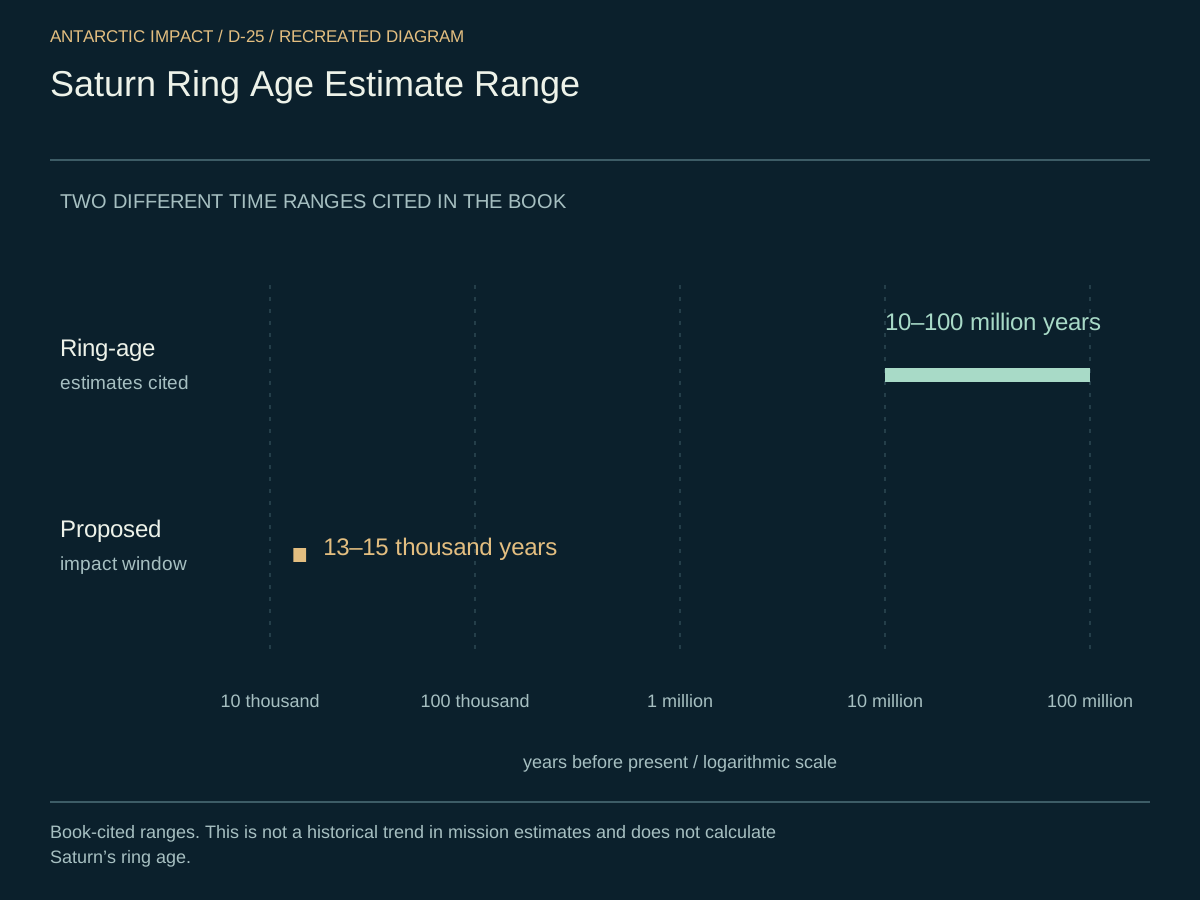
And here is the trend in ring-age estimates over the past few decades. The number used to be "as old as Saturn." It is now ten to a hundred million years, and the low end keeps drifting down. The rings are young, and getting younger with every mission. Our window sits at the end of that trend.
The Pattern: Southern Polar Impacts
The recurring southern-pole concentration of catastrophic impact features across Earth, Mars, the Moon, and Pluto is one of the strongest threads in this book. A directional swarm — a wave of bodies arriving from a specific orbital orientation, rather than from random directions — produces exactly this asymmetry. Random arrivals over geological time would have averaged the bias out. What we see is the opposite: a swarm, arriving from one direction, in one season of the solar system's life.
Five small globes, each oriented south-pole-down, each with its largest impact-related feature highlighted in the same color. Earth at Antarctica, Mars at Hellas, the Moon at SPA, Mercury at Caloris, Pluto at Sputnik Planitia. That clustering is the visual argument, and it is the picture I keep coming back to.
Estimating the Antarctic Comet
To estimate the size of the comet that made Antarctica, we work from two directions.
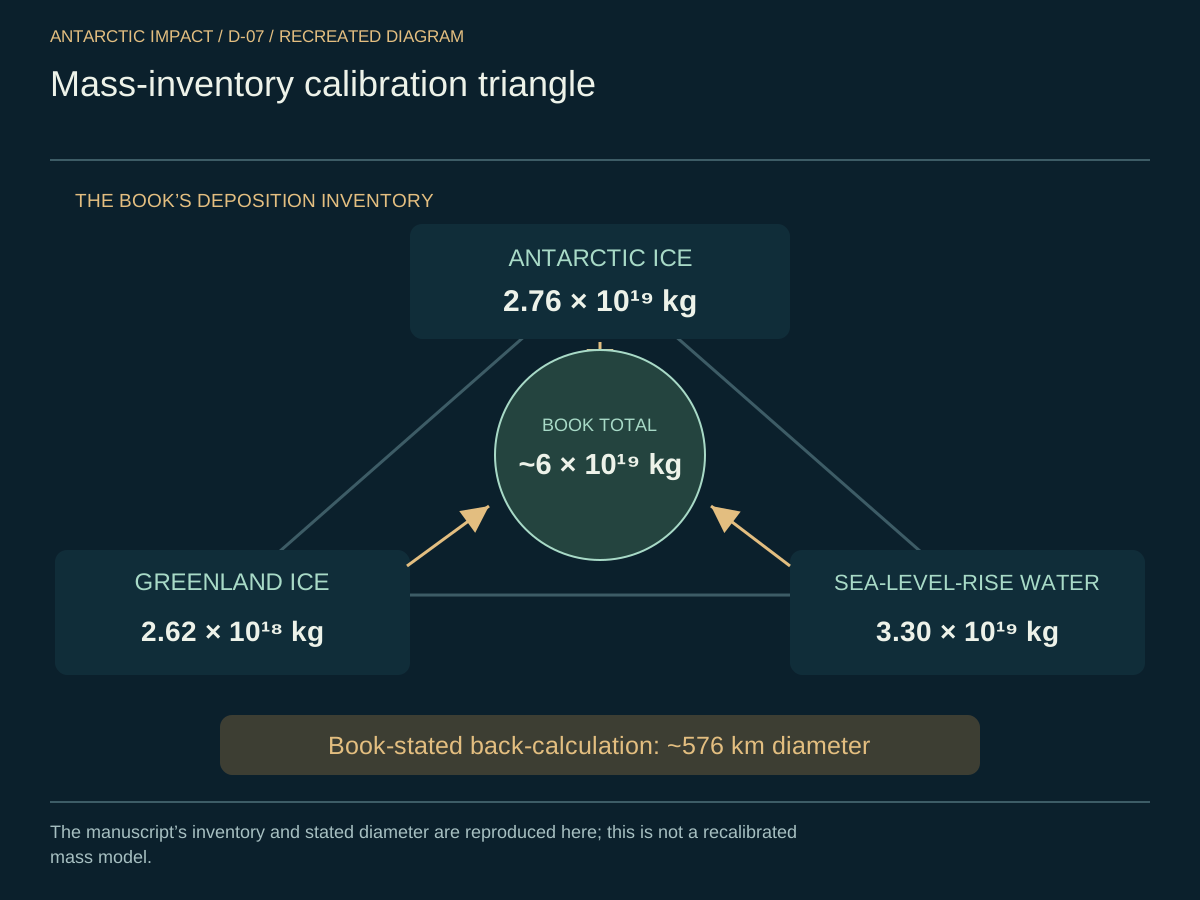
The first is deposition. Combining the total mass of Antarctica's ice (on the order of 2.76 × 10¹⁹ kg), the ice covering Greenland (around 2.62 × 10¹⁸ kg), and the roughly three hundred feet of global sea-level rise from melting cometary ice (approximately 3.30 × 10¹⁹ kg), we arrive at a deposited mass of roughly 6 × 10¹⁹ kg. Modeled as a sphere of compressed nitrogen ice, that mass back-calculates to a diameter on the order of five hundred and seventy-six kilometers.
The second is dynamics. A compressed nitrogen-ice body roughly five hundred kilometers in diameter, at a density of about a thousand kilograms per cubic meter, has a total mass on the order of 6.5 × 10¹⁹ kg — about one ten-millionth of Earth's mass. (See the Supporting Math appendix for the worked example.) The deposited-mass figure above counts only the ice that ended up on Earth; the total body, including the dense core under Wilkes Land, is larger still.
Two independent reckonings converge on a body in the same range — a few hundred kilometers across, with the order-of-magnitude scaling we use throughout this book. That is the scale of the comet.
Here is the calibration triangle. Antarctic ice mass on one corner, Greenland ice on a second, sea-level-rise water on the third — adding up to roughly six times ten to the nineteenth kilograms, which back-calculates to a sphere about five hundred and seventy-six kilometers across.
Synthesis: A Solar-System-Wide Narrative
From Mars's Hellas Basin to Pluto's Sputnik Planitia, from Triton's active nitrogen geysers to the Moon's South Pole–Aitken Basin and Mercury's Caloris, the evidence tells one story:
- Great impacts and basins formed in the recent past.
- Vast deposits of nitrogen ice laid down on distant worlds.
- Extreme axial tilts, chaotic spins, and unusual orbits — the marks of powerful external forces.
All of these point to a single wave of nitrogen-ice comet impacts in the last twenty thousand years or so — reshaping not only Earth, but also Mars, the Moon, Mercury, Pluto, Triton, and beyond.
For us, Antarctica remains the most tangible piece of evidence: the frozen heart of a catastrophic impact that cracked continents apart and heralded the Ice Age. But this is not only Earth's story. It is the solar system's story — a single, colossal event that remodeled Earth's surface and left its marks on every planet and moon in the swarm's path.